
The SMC submission guide: how the Scottish Medicines Consortium assesses new medicines in 2026
Scotland runs its own assessment of every newly licensed medicine, on its own timetable and with its own forms, committees and flexibilities. With a new process guide, a new NPAF for the January 2027 intake and new position statements on AI and real-world evidence, 2026 is a good moment to look closely at how an SMC submission actually works.
Why Scotland deserves its own plan
Our overview of SMC and AWMSG sets out how Scotland and Wales sit alongside NICE. This piece stays in Scotland and goes a level deeper: who holds each decision, what happens week by week, what the 2026 documents change, and how the Scottish Medicines Consortium (SMC) reads economic evidence.
The starting point is simple. SMC, part of Healthcare Improvement Scotland, advises NHSScotland on the value for patients of newly licensed medicines, new formulations and new uses of established medicines, and a medicine has to be accepted for use by SMC before it can be prescribed routinely in Scotland. SMC was introduced in 2002, replacing advice from 14 separate local Area Drug and Therapeutics Committees.[1] Scottish Government policy states that NHS Boards are expected to follow SMC advice and, where SMC accepts a medicine, to make it, or an equivalent, available.[2]
Volume is rising. In 2024-25 SMC published 96 pieces of advice, up from 87 in 2023-24, with 66% of medicines accepted and 34% not recommended. Patient groups made 77 submissions, up from 69, and 88% of decisions were communicated within the target timeframe against a target of 75%.[3]
Source: Healthcare Improvement Scotland, Annual report and accounts 2024-25.
Who decides: four layers, each with a distinct job
SMC advice is the product of several groups working in sequence. Understanding what each one is asked to do is the most practical way to shape a submission.[4]
| Group | Composition | Role in the submission |
|---|---|---|
| Assessment team | A pharmacist, a health economist, a health services researcher and an NDC member acting as lead assessor, with statistical support | Reviews the NPAF and model, completes clinical, economic and indirect comparison checklists, and issues clarification requests |
| New Drugs Committee (NDC) | Around 20 members: clinicians, pharmacists, nurses and industry members | Meets in private, usually on the last Tuesday of the month, and issues preliminary advice in a Detailed Advice Document (DAD) |
| SMC Executive | The chair, the NDC and SMC Committee vice chairs, the SMC Clinical Adviser and senior staff | Considers positive NDC recommendations; these decisions are then shared at a Committee meeting |
| SMC Committee | Around 25 members, with all 14 NHS boards represented through ADTC nominations, plus managers, health economists, public partners and industry members | Considers medicines where NDC preliminary advice is not recommended, together with patient group submissions and any PACE statement, and votes by simple majority |
The Committee usually meets on the first Tuesday of the month. Discussion is held in public, with a closed second part for commercially confidential material, and each medicine usually takes around 30 minutes. Voting is electronic and vote numbers are confidential. Companies may register up to two representatives, whose role is to respond to questions, comment on factual accuracy and clarify outstanding issues as directed by the chair; attendance is optional and does not affect the review.[4]
Two features are worth holding in mind. First, the routing of positive NDC advice to the SMC Executive means that a clear, well-supported case can reach a decision without a Committee debate. Second, the Committee sees the broadest evidence base of any stage, including clinical expert feedback and patient group submissions, so the narrative around the model matters as much as the model itself.
The submission journey, step by step
Before the submission
Companies may submit after a positive opinion from the Committee for Medicinal Products for Human Use, or up to two months before final MHRA approval. Where submission plans have not already been discussed with SMC staff, the company must contact SMC before submitting or resubmitting.[5] A Company Information Request Form can be used where it is unclear whether a product is within remit or what type of submission is needed. Table 1 of the process guide lists 18 out-of-remit criteria, including medicines first licensed in the UK before 31 January 2002, vaccines covered by JCVI guidance, generics and biosimilars.[4]
Formal early engagement meetings exist but are offered in specific circumstances, for example where a submission may not be forthcoming and patient need is exceptionally high. SMC aims to respond to such requests within 15 working days.[4] SMC does not offer pre-submission scoping, so the company defines the decision problem itself.[6]
From scheduling to advice
Submissions are scheduled against a published NPAF timetable, and an incomplete submission cannot be scheduled. Once dates are confirmed, the company cannot withdraw except for regulatory or licensing reasons.[4]
- Contact and remit checkCompany Information Request Form or Secretariat contact
- NPAF and PAS submittedScheduled once complete; PAS goes to PASAG in parallel
- Assessment and clarificationAssessment team review; further analyses often requested
- NDC preliminary adviceDAD issued; 10 working days for company comments
- SMC Executive or CommitteeExecutive for positive NDC advice; Committee (with PACE where eligible) otherwise
- AcceptedRoutine use in NHSScotland
- Accepted with restrictionsUse within a defined population or setting
- Interim acceptanceConditional, ILAP or EAMS routes, pending confirmatory data
- Not recommendedResubmission, fast-track or review routes remain open
After submission and before NDC, the Secretariat often asks for further information, clarification or additional health economic analyses, sometimes with short turnaround times. NDC sends its preliminary recommendation in confidence on the Friday after the meeting, and the company then has 10 working days to comment; a new or revised PAS can be submitted within two weeks of the preliminary advice.[4]
The usual overall timeline is 18 weeks from scheduling to advice. It is usually 26 weeks for end-of-life and orphan medicines that need a PACE meeting, for complex PAS and occasionally for complex submissions. The gap between NDC and SMC is usually six or ten weeks depending on PACE eligibility. The company and NHS boards are informed in confidence on the Friday after the SMC meeting, and advice is published four weeks after that meeting.[4]
- Scheduling confirmedAssessment timeline and NDC date agreed
- ClarificationQuestions and extra analyses
- NDC meetingHeld in private
- DAD issuedPreliminary advice in confidence
- Company commentsRevised PAS within two weeks
- SMC decisionExecutive or Committee
- PublicationUsually 18 weeks overall; 26 with PACE
Source: SMC process guide for submitting companies, October 2026.
In our experienceThe clarification window is where Scottish submissions are often shaped most. Teams that have pre-built the scenario analyses an assessor is likely to ask for, with clean switches in the model, can respond within short turnaround times while maintaining quality.
The 2026 documents and the NPAF for January 2027
SMC refreshed its core company documents in autumn 2026. A new process guide (version 1.0) was published in October 2026, and a new NPAF set applies to medicines submitted from the January 2027 intake, including resubmissions and ultra-orphan pathway submissions. Submissions before then continue on the previous forms.[5]
| Document | Date | What it means for companies |
|---|---|---|
| Process guide for submitting companies v1.0 | October 2026 | Single reference for committees, timelines, PACE, interim acceptance, ultra-orphan, abbreviated and resubmission routes |
| NPAF v4.0, NPAF guidance, ultra-orphan NPAF v2.0 | October 2026; for the January 2027 intake | New template set for full submissions, resubmissions and ultra-orphan submissions |
| AI position statement v1.0 | October 2026 | Disclosure of AI use, documented human oversight |
| Company Information Request Form v2.0 | October 2026 | Remit and submission-type queries |
| Indirect treatment comparison checklist v3.0 | May 2026 | The checklist assessors use for ITCs |
| Position statement on real-world evidence v1.0 | July 2025 | Expectations for RWE quality, transparency and integration |
Source: SMC Making a submission page, file dates as listed.[5]
What the NPAF asks for
The NPAF guidance sets out the registration details, an overview, direct and indirect evidence, clinical effectiveness, economic evaluation, budget impact and a plain-language summary for patient groups. Several details reward early attention.[6]
- Selective submissions: A company may make a case for a narrower population than the licence, stated explicitly in the NPAF, with a single population carried consistently through the clinical case, the economic case and the budget impact template.[4, 6]
- Indirect comparisons: A 25-item checklist with page references covers methods, network diagrams, model choice, heterogeneity, inconsistency and sensitivity analyses, and search strategies must be fully reported.
- Reference case: The comparator is the treatment most likely to be displaced in NHSScotland. Health effects are taken from the patient perspective in the base case, with a patient-and-carer perspective as additional analysis; costs are those of NHSScotland and social work; cost-utility analysis is preferred, with EQ-5D and UK valuation; costs and benefits are discounted at 3.5%.
- Prices: Medicine prices come from BNF or MIMS, and eMIT is not acceptable. VAT is excluded from the economic evaluation and included in the budget impact.
- Confidential comparator prices: The preferred model lets SMC enter confidential PAS or contract discounts and rerun the base case, scenarios and probabilistic and one-way analyses. Otherwise, results must be reported across comparator discounts from 5% to 95% in 5% steps.
- Budget impact: The SMC template covers the rest of the launch financial year and two further full financial years.
AI and real-world evidence
The AI position statement asks companies to state whether, where and how AI has been used, to report the model version and dates of use, and to document human oversight. For analytically important tasks such as evidence synthesis or modelling, SMC notes that the prompt is considered part of the methodology.[7] The RWE statement positions real-world evidence as supplementary evidence that can fill gaps, particularly in rare conditions and in showing generalisability to NHSScotland, provided sources are transparent, bias is addressed and uncertainty is carried through scenario and sensitivity analyses.[8]
Decision types and what the data show
A full submission can lead to four outcomes: accepted, accepted with restriction(s), not recommended, or interim acceptance. At reassessment on the ultra-orphan pathway, the outcomes are accepted for use, accepted for restricted use, or not recommended.[4] Where a company does not submit, SMC issues not recommended advice soon after the medicine becomes available, and later advice based on a submission supersedes it.[4]
The workload has grown over time. Healthcare Improvement Scotland reported 65 pieces of advice in 2018-19, 73 in 2019-20, 60 in 2020-21, 81 in both 2021-22 and 2022-23, 87 in 2023-24 and 96 in 2024-25.[3, 9, 10] In 2022-23, the 81 submissions received comprised 64 full submissions, 2 standard abbreviated submissions and 15 abbreviated therapeutic class submissions.[10]
- 2018-1965
- 2019-2073
- 2020-2160
- 2021-2281
- 2022-2381
- 2023-2487
- 2024-2596
Bar length relative to 100. Sources: Healthcare Improvement Scotland annual reports and accounts 2022-23, 2023-24 and 2024-25.
Two readings follow. The aggregate acceptance figure covers a mix of full and abbreviated submissions, so it is a system-level indicator rather than a probability for any one medicine. And with volume rising, the quality and completeness of each NPAF has a direct bearing on how smoothly it moves through a busy assessment pipeline.
How SMC reads cost-effectiveness evidence
SMC states that it does not have a formal threshold cost per QALY below which cost-effectiveness would be considered shown, and that the cost per QALY is only part of a wider judgement.[4] This differs in form from NICE, which confirmed a standard range of £25,000 to £35,000 per QALY from April 2026, up from £20,000 to £30,000.[11] We have not seen SMC adopt a numerical range, and we would not assume read-across from NICE (see our guide to NICE technology appraisal in 2026).
In place of a threshold, SMC sets out two kinds of flexibility.[4]
- More uncertainty in the economic case may be accepted for orphan medicines, using the MHRA prevalence criterion of not more than 5 in 10,000.
- A higher cost per QALY may be accepted where there is a substantial improvement in life expectancy (normally a median gain of three months), a substantial improvement in quality of life, a targeted subgroup with greater benefit, no other proven therapeutic options, possible bridging to a definitive therapy, or a licensed alternative to an unlicensed product.
The qualifier matters: modifiers are applied only when the committee is satisfied that the clinical and economic case is robust.[4] In our experience, this makes transparency about uncertainty the strongest lever a company has. A model whose structural choices are well justified, whose key scenarios are pre-specified and whose drivers are visible gives the committee room to use its flexibilities.
Worked example: the comparator discount grid
Where a comparator carries a confidential price the company cannot see, the NPAF asks for results across discounts of 5% to 95% in 5% steps, unless SMC can enter the discount directly.[6] The arithmetic is linear and worth understanding before the model is built.
ICER(d) = [C_new − C_comp × (1 − d)] / ΔQALY
Illustrative inputs: lifetime cost of the new medicine £60,000 (including its own PAS), comparator drug cost at list price £40,000, other costs equal, and an incremental gain of 0.50 QALYs.
| Comparator discount (d) | Incremental cost | ICER (£ per QALY) |
|---|---|---|
| 5% | £22,000 | £44,000 |
| 25% | £30,000 | £60,000 |
| 50% | £40,000 | £80,000 |
| 75% | £50,000 | £100,000 |
| 95% | £58,000 | £116,000 |
Illustrative. Each percentage point of comparator discount adds £400 to the incremental cost and £800 to the ICER (£40,000 × 0.01 / 0.50). The implication is practical: the larger the comparator's drug-cost share, the steeper the grid, and the more value there is in a model that lets SMC enter the confidential price and see a single, correct answer.
In Scotland the model is half of the submission. The other half is how clearly the company shows what the numbers cannot capture, and why that matters to patients.
PACE, ultra-orphan and interim acceptance
Scotland has built distinct routes for rare and end-of-life medicines, and each has its own entry conditions.
PACE
The Patient and Clinician Engagement (PACE) process applies to end-of-life and orphan or orphan-equivalent medicines when NDC preliminary advice is not recommended and the company has requested PACE in its NPAF. SMC defines an end-of-life medicine as one for a condition at a stage that usually leads to death within three years with currently available treatments, and an orphan medicine by a population of fewer than 2,500 people in 5 million.[4] The meeting brings together a chair with SMC experience, an SMC public partner, patient group representatives and clinicians from the specialty, and the company may submit a brief statement.[12]
The PACE statement captures benefits across three themes: for patients (quality of life, work or education, symptoms, independence and dignity), for families and carers (time, personal care, the carer's ability to work), and clinical (unmet need, severity, place in the pathway, service changes). SMC describes the output as a major factor in its decision, and PACE adds one to three months to the timeline.[12]
PACE was introduced in 2014. A 2023 study of how SMC committee members and PACE participants rated patient-based evidence found that health benefits had the highest level of agreement between the two groups.[13] An independent review for the Scottish Government in 2016 observed that acceptance rates for end-of-life and orphan medicines appeared to be on a par with other medicines considered by SMC.[14]
Standard full submission
- Usual timeline of 18 weeks
- NDC, then SMC Executive or Committee
- Modifiers available where the case is robust
End-of-life and orphan (PACE)
- Death usually within 3 years, or fewer than 2,500 in 5 million
- PACE meeting if NDC advice is not recommended
- Usually 26 weeks; statement reused within 6 months
Ultra-orphan pathway
- Four criteria, including prevalence of 1 in 50,000 or less
- Validation within around 8 weeks, valid for 2 years
- Available for up to 3 years while data are gathered
Sources: SMC process guide (2026), PACE overview, ultra-orphan pathway page.
The ultra-orphan pathway
A medicine qualifies only if all four criteria are met: a prevalence of 1 in 50,000 or less in Scotland, a GB orphan marketing authorisation, a chronic and severely disabling condition, and a need for highly specialised management. Validation is confirmed within around eight weeks and expires after two years.[15] The Scottish Government sets three conditions: a full submission for initial assessment, a PAS compliant with PASAG terms, and support for data collection. The initial assessment is carried out by NDC, without Committee discussion or PACE at that stage.[4] Validated medicines are available for up to three years while further effectiveness data are gathered,[15] and a full updated submission is due within three months of the end of evidence generation.[4]
Interim acceptance
Medicines with a UK conditional marketing authorisation, ILAP inclusion or a positive EAMS scientific opinion are eligible, provided ongoing studies could address the key uncertainties. A full clinical and economic evaluation is still required. Voting has two stages: if the first vote does not accept the medicine, a second vote decides between interim acceptance and not recommended. An updated submission is required once the authorisation converts to a standard one, typically after two to three years.[4] For evidence planning, interim acceptance and managed access share a principle: they work best when the confirmatory data are clearly mapped to the uncertainties that matter for the decision.
Patient access schemes, resubmissions and abbreviated routes
PAS and PASAG
The Patient Access Scheme Assessment Group (PASAG) reviews and advises NHSScotland on the feasibility of proposed schemes and operates separately from SMC. Standard terms published in January 2020 apply to PAS submissions from 1 March 2020, updated standard terms were included in application forms from December 2025, and companies choose between a concise and a full application.[16] SMC considers the financial benefit of a PAS only once PASAG has accepted it, and early submission alongside the NPAF is strongly encouraged because a later PAS may extend timelines.[4]
Resubmission routes
- Full resubmission requires new clinical evidence or new analysis and normally follows standard timelines.
- Fast-track resubmission, within three months of the original decision, is available once per medicine where the only change is a new or improved simple PAS or a list price reduction confirmed with the Department of Health. There is no NDC stage, and the timeline is usually up to 14 weeks.
- PACE resubmission within six months of the PACE meeting reuses the original PACE statement.
- Independent Review Panel is available up to 12 months after publication where there are no new data or analyses, provided no resubmission is underway.
Source: SMC process guide, October 2026.[4]
Abbreviated submissions
Abbreviated routes apply where a full submission is not required because net budget impact is low. A new active substance or a new indication still needs a full submission. The therapeutic class route, introduced as an interim measure in October 2020 and since made permanent, asks the company to show that the medicine is an alternative within a class whose members SMC has accepted or restricted, with similar clinical effectiveness and overall cost.[4, 17] SMC no longer requests abbreviated submissions for paediatric licence extensions where adult advice exists.[4]
What this means for evidence planning
- Agree the submission date earlyContacting the Secretariat in good time keeps Scotland in step with UK launch sequencing
- Define the Scottish decision problemWithout scoping, the comparator most likely to be displaced in NHSScotland anchors the case
- Build for the January 2027 NPAFVersion 4.0 applies to submissions from that intake, including resubmissions
- Let SMC enter confidential pricesOne correct answer reads more clearly than a full discount grid
- Pre-build the likely scenariosClarification turnaround times are short; ready switches support quality
- Claim PACE or ultra-orphan status deliberatelyPACE is requested in the NPAF; ultra-orphan validation takes around eight weeks
- Submit the PAS with the NPAFEarly PASAG review supports the usual timeline
- Document AI use and RWE methodsBoth now have published SMC expectations
Three further points come from our work on Scottish submissions. Budget impact deserves its own attention: the SMC template's short horizon, covering the remainder of the launch year and two full financial years, places weight on early uptake assumptions, which is where a dedicated budget impact model pays off. Models adapted from an England submission benefit from a deliberate Scotland configuration rather than a relabel, a theme we explore in adapting global models for NICE and NCPE. And patient group and clinical expert engagement is most valuable when it starts well before any PACE meeting is in view.
If your launch plan also includes Wales, our guide to AWMSG and medicines access in Wales covers the routes there.
How Evidaxia can help
Evidaxia supports SMC full submissions, resubmissions and ultra-orphan applications, from the NPAF and Scotland-configured economic model to clarification responses, PAS analyses and PACE preparation. See our SMC submissions service and HTA submissions across the UK, or contact us to discuss a Scottish launch.
References
- Scottish Medicines Consortium. What we do [Internet]. Glasgow: Scottish Medicines Consortium; [date unknown] [cited 2026 Nov]. Available from: https://scottishmedicines.org.uk/about-us/
- Scottish Government Healthcare Policy and Strategy Directorate. Introduction and availability of newly licensed medicines in the NHS in Scotland. CEL 17 (2010) [Internet]. Edinburgh: Scottish Government; 2010 May 17 [cited 2026 Nov 1]. Available from: https://scottishmedicines.org.uk/media/2729/the-introduction-and-availability-of-medicines.pdf
- Healthcare Improvement Scotland. Annual report and accounts 2024-2025 [Internet]. Edinburgh: Healthcare Improvement Scotland; 2025 [cited 2026 Nov 1]. Available from: https://www.healthcareimprovementscotland.scot/wp-content/uploads/2025/09/Annual-Accounts-2024-25.pdf
- Scottish Medicines Consortium. SMC process guide for submitting companies, version 1.0 [Internet]. Edinburgh: Healthcare Improvement Scotland; 2026 Oct [cited 2026 Nov 1]. Available from: https://scottishmedicines.org.uk/media/10769/20261022-smc-process-guide-for-submitting-companies-v10.pdf
- Scottish Medicines Consortium. Making a submission [Internet]. Glasgow: Scottish Medicines Consortium; [date unknown] [cited 2026 Nov]. Available from: https://scottishmedicines.org.uk/making-a-submission/
- Scottish Medicines Consortium. Guidance to submitting companies for completion of New Product Assessment Form (NPAF) [Internet]. Edinburgh: Healthcare Improvement Scotland; 2026 Oct [cited 2026 Nov 1]. Available from: https://scottishmedicines.org.uk/media/10768/20261021-guidance-to-submitting-companies-for-completion-of-npaf.pdf
- Scottish Medicines Consortium. SMC AI position statement, version 1.0 [Internet]. Edinburgh: Healthcare Improvement Scotland; 2026 Oct 22 [cited 2026 Nov 1]. Available from: https://scottishmedicines.org.uk/media/10770/20261022-smc-ai-position-statement_v-10.pdf
- Scottish Medicines Consortium. SMC position statement on real-world evidence, version 1.0 [Internet]. Edinburgh: Healthcare Improvement Scotland; 2025 Jul 28 [cited 2026 Nov 1]. Available from: https://scottishmedicines.org.uk/media/9316/2025-07-28-smc-position-statment-on-rwe-v10.pdf
- Healthcare Improvement Scotland. Annual report and accounts 2023-2024 [Internet]. Edinburgh: Healthcare Improvement Scotland; 2024 [cited 2026 Nov 1]. Available from: https://www.healthcareimprovementscotland.scot/wp-content/uploads/2024/10/HIS-Annual-Report-and-Accounts-2023-2024.pdf
- Healthcare Improvement Scotland. Annual report and accounts for the year ended 31 March 2023 [Internet]. Edinburgh: Healthcare Improvement Scotland; 2023 [cited 2026 Nov 1]. Available from: https://www.healthcareimprovementscotland.scot/wp-content/uploads/2024/02/Healthcare_Improvement_Scotland_Annual_Report_and_Accounts_for_the_year_ended_31_March_2023.pdf
- National Institute for Health and Care Excellence. Changes to NICE's cost-effectiveness thresholds confirmed [Internet]. London: National Institute for Health and Care Excellence; 2025 Dec 1 [cited 2026 Nov 1]. Available from: https://www.nice.org.uk/news/articles/changes-to-nice-s-cost-effectiveness-thresholds-confirmed
- Scottish Medicines Consortium. Patient and Clinician Engagement (PACE) meetings overview, version 4.0 [Internet]. Glasgow: Scottish Medicines Consortium; [date unknown] [cited 2026 Nov 1]. Available from: https://scottishmedicines.org.uk/media/8998/pace-overview-v40.pdf
- Hems S, Taylor L, Jones J, Holmes E. Patient-based evidence: its role in decision making on end-of-life, orphan, and ultra-orphan medicines. Int J Technol Assess Health Care. 2023;39(1):e19. Available from: https://doi.org/10.1017/S026646232300003X
- Montgomery B. Review of access to new medicines: independent review. Section 7: conclusions [Internet]. Edinburgh: Scottish Government; 2016 Dec 14 [cited 2026 Nov 1]. Available from: https://www.gov.scot/publications/review-access-new-medicines/pages/18/
- Scottish Medicines Consortium. Ultra-orphan medicines for extremely rare conditions [Internet]. Glasgow: Scottish Medicines Consortium; [date unknown] [cited 2026 Nov]. Available from: https://www.scottishmedicines.org.uk/how-we-decide/ultra-orphan-medicines-for-extremely-rare-conditions/
- Scottish Medicines Consortium. Patient access schemes [Internet]. Glasgow: Scottish Medicines Consortium; [date unknown] [cited 2026 Nov]. Available from: https://scottishmedicines.org.uk/making-a-submission/companies/patient-access-schemes/
- Scottish Medicines Consortium. Abbreviated submissions [Internet]. Glasgow: Scottish Medicines Consortium; [date unknown] [cited 2026 Nov]. Available from: https://scottishmedicines.org.uk/how-we-decide/abbreviated-submissions/
Sources accessed October 2026. This article is analysis for information and is not legal, regulatory or tax advice.
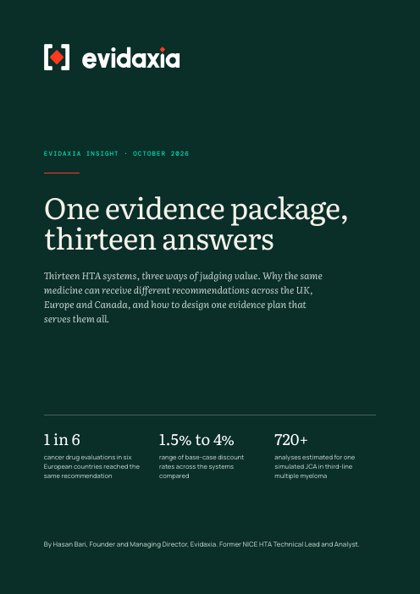
One evidence package, thirteen answers.
Our 21-page guide compares thirteen HTA systems across the UK, Europe and Canada, with 16 exhibits and full references. Subscribe to Evidaxia Briefing, our sourced analysis of market access, HTA decisions, evidence and health policy, and the guide downloads the moment you subscribe.
How long does an SMC submission take?
The usual SMC timeline is 18 weeks from scheduling to advice. It is usually 26 weeks where a PACE meeting, a complex PAS or occasionally a complex submission is involved, and fast-track resubmissions usually take up to 14 weeks.
What is the difference between the New Drugs Committee and the SMC Committee?
The New Drugs Committee reviews the evidence in private and issues preliminary advice. Positive NDC recommendations go to the SMC Executive, while medicines with preliminary advice of not recommended go to the SMC Committee, which also considers patient group submissions and any PACE statement.
Does the Scottish Medicines Consortium have a cost per QALY threshold?
No. SMC states that it does not have a formal threshold cost per QALY and that cost per QALY is only part of a wider judgement. It may accept a higher cost per QALY or more uncertainty where modifiers apply and the case is robust.
What changes in the SMC NPAF for 2027?
A new NPAF version 4.0, with new guidance and an ultra-orphan NPAF version 2.0, applies to submissions from the January 2027 intake, including resubmissions. SMC also published a new process guide and an AI position statement in October 2026.
What share of medicines does SMC accept?
In 2024-25, Healthcare Improvement Scotland reported that SMC published 96 pieces of advice, with 66% of medicines accepted and 34% not recommended.
When is a medicine eligible for SMC interim acceptance?
Medicines with a UK conditional marketing authorisation, ILAP inclusion or a positive EAMS scientific opinion are eligible where ongoing studies could address the key uncertainties. An updated submission is required once the authorisation converts to a standard one, typically after two to three years.
Related analysis
Planning a Scottish launch? Build an SMC-ready submission from the start.
Start with a free, no-obligation 30-minute call with a senior consultant.