
Adapting a global cost-effectiveness model for NICE and NCPE: what really has to change
Most UK and Irish submissions start from a global model. Turning it into one that NICE or NCPE can rely on means rebuilding the decision problem around a specific health system, not just swapping in local prices.
Why adaptation is more than a price change
A global cost-effectiveness model is usually built to answer a general question for many markets at once. An HTA body answers a narrower one: is this technology good value for this health system, compared with the care that this system actually provides? The perspective, the discount rate, the comparators, the unit costs, the utility algorithm and the decision rule can all differ between England and Ireland, and each difference moves the incremental cost-effectiveness ratio (ICER).
In our experience, the adaptations that cause most trouble at assessment are not the obvious ones. Assessors check the discount rate as a matter of course. They also notice a comparator that is not used locally, a resource-use assumption carried over from another country, a utility mapping that does not match the reference case, or a model whose results cannot be reconciled with the global version. This article sets out what changes, why it matters numerically, and how to document it so that an external assessment group or NCPE reviewer can follow every step.
Four reference cases, side by side
NICE's reference case for England takes an NHS and personal social services (PSS) perspective on costs, includes all health effects for patients and, where relevant, carers, and discounts costs and health effects at 3.5% a year. A lifetime horizon is usually appropriate, and is needed when technologies differ in survival.[1] HIQA's national guidelines for Ireland, version 2.0 (March 2025), specify a cost-utility analysis from the perspective of the publicly funded health and social care system (the HSE), all health benefits to individuals, routine care in Ireland as the comparator, and an annual discount rate of 4.0% on costs and outcomes occurring after the first year.[2]
Scotland and Wales sit closer to England. SMC's guidance to companies asks for a costing perspective of NHS Scotland and social work, a 3.5% discount rate, and comparators that reflect Scottish practice; it does not define a single mandatory reference case and recommends NICE's where companies wish to use one.[3] AWMSG's June 2025 guidance asks for an NHS Wales and PSS perspective, 3.5% discounting, Welsh resource use and costs where they exist, and an electronic model, preferably in Excel.[4]
| Element | NICE (England) | NCPE / HIQA (Ireland) | SMC (Scotland) | AWMSG (Wales) |
|---|---|---|---|---|
| Cost perspective | NHS and PSS | Publicly funded health and social care system (HSE) | NHS Scotland and social work | NHS Wales and PSS |
| Discount rate (base case) | 3.5% costs and effects | 4.0% costs and outcomes after year 1 | 3.5% | 3.5% |
| Alternative discounting | 1.5% may be presented in specific circumstances | Vary 0% to 10%, plus ±1%; hyperbolic as secondary analysis if horizon >30 years | Vary between 0% and 6% when results are sensitive | 1.5% may be acceptable in specific circumstances, as a scenario |
| Comparator | As defined in the NICE scope | Routine care in Ireland | Current Scottish practice | Not specified in the economic section; NICE advice usually applies in Wales |
| Local costs | Prices the NHS actually pays, including known discounts | Irish cost data where possible; VAT excluded | Scottish context; VAT excluded from the economic evaluation | Welsh data; other UK data not accepted if Welsh data exist |
Sources: NICE PMG36,[1] HIQA 2025,[2] SMC 2022,[3] AWTTC 2025.[4] The decision rule has also moved. NICE confirmed in December 2025 that its standard threshold range would rise to £25,000 to £35,000 per QALY from April 2026, and its manual has since been updated.[5, 6]
Discounting: a worked example
The 0.5 percentage point gap between England and Ireland looks small. Its effect depends on when the benefits arrive. HIQA's guidelines give the discount factor as:
discount factor(t) = 1 / (1 + r)^t, with t = 0, 1, 2, ... n
so that values in the first year (t = 0) are not discounted.[2] Discounted QALYs are then Σ QALY(t) × 1/(1 + r)^t. We use the same annual convention for both countries so that only the rate differs.
Take a one-off therapy that delivers an incremental 0.8 QALYs a year for 40 years, with an incremental cost of £300,000 incurred at t = 0 (so the cost is not discounted under either rate).
| Annual discount rate | Discounted incremental QALYs (40 years) | Share of QALYs from years 21 to 40 | ICER (cost/QALY) |
|---|---|---|---|
| 0% | 32.00 | 50.0% | 9,375 |
| 1.5% | 24.29 | 42.6% | 12,350 |
| 3.5% (NICE, SMC, AWMSG) | 17.68 | 33.4% | 16,966 |
| 4.0% (HIQA / NCPE) | 16.47 | 31.3% | 18,218 |
Moving from 3.5% to 4% removes 6.9% of the discounted QALYs and raises the ICER by about 1,250 per QALY. Over a five-year horizon the same change removes less than 1% (3.74 versus 3.70 QALYs). The reason is visible in the discount factors: a QALY in year 39 is worth 0.261 of an undiscounted QALY at 3.5% but 0.217 at 4%. For gene therapies, cell therapies and other technologies whose value sits in long-term survival, the Irish rate therefore bites hardest exactly where the model is already most uncertain.
Practical pointBuild the discount rate, the timing convention (start or mid-cycle) and the first-year rule as explicit, labelled inputs. Then run the global, English and Irish settings from the same file and reconcile the results. An assessor who can reproduce the movement from one reference case to another will trust the adaptation more.
Costs matter too. Where the incremental cost is spread over time, as with chronic therapies, discounting reduces both numerator and denominator and the net effect on the ICER is smaller. Where costs are front-loaded and benefits are long-lived, as above, the effect is largest.
Comparators and treatment pathways
NICE asks for comparison with established NHS practice, with comparators and patient groups defined in the scope NICE develops.[1] HIQA defines the comparator as routine care in Ireland, meaning the technologies most widely used.[2] SMC asks for Scottish practice and, where practice varies, prefers comparators based on Scottish treatment or audit data.[3]
These definitions can lead to different models even when the clinical evidence is shared. A medicine that is routine in England may be unfunded or used differently in Ireland, and the reverse. Subsequent treatments matter as much as the comparator: if a global model assumes a post-progression regimen that is not reimbursed locally, both costs and overall survival in the extrapolated phase may not hold. We would expect a credible adaptation to include a short, referenced description of the local pathway, confirmed with clinicians practising in that system, and a clear statement of which treatment-sequence assumptions changed.
Where a comparator is available under a confidential discount, England, Scotland and Ireland handle this in different ways. SMC, for example, asks companies to model a range of comparator discounts from 5% to 95% in 5% steps when a key comparator has a confidential patient access scheme.[3] Build the model so that comparator prices can be switched without touching formulas.
Local costs: England and Ireland
England
NICE asks for prices that reflect, as closely as possible, what the NHS actually pays, including known price reductions. For medicines mainly prescribed in primary care, prices are based on the Drug Tariff; eMIT and Commercial Medicines Unit prices are recognised sources for hospital medicines, with the caveat that they are not guaranteed for the life of the guidance.[1] eMIT reports average prices paid by NHS hospitals for generic medicines, excluding VAT; its latest update (August 2026) covers the 12 months to June 2026.[7] List prices for branded medicines are commonly taken from the BNF, which SMC also names as a source of unit prices.[3]
Hospital activity is usually costed from the National Cost Collection, which NICE describes as the annual mandatory collection of reference costs from NHS organisations in England.[1] The 2024/25 collection is published as Power BI dashboards, with unadjusted and market forces factor adjusted versions.[8] Staff time and community and social care are usually costed from the Unit Costs of Health and Social Care manual; the 2025 edition was published by PSSRU (University of Kent) and the Centre for Health Economics (University of York).[9] NICE also cites the PSSRU report as a source for inflating costs to the current year.[1]
Ireland
HIQA asks for Irish cost data where possible, with the origin of each cost identified and justified. Hospital activity is typically macro-costed using diagnosis-related group (DRG) costs, community medicine prices come from the Primary Care Reimbursement Service (PCRS) reimbursement files, and staff costs use consolidated salary scales. Transfer payments such as VAT are excluded from the economic evaluation.[2]
NCPE's own drug-costing guidelines (version 3.4, April 2026) add the detail that most global models lack.[10] The reimbursement price is the price to wholesaler plus a wholesale mark-up of 8%, or 12% for fridge items, in the community schemes. A dispensing fee of €4.97 per item is recommended for community schemes, while pharmacy fees are not applied to hospital medicines. Under the Framework Agreement on the Supply and Pricing of Medicines 2026 to 2029, the rebate on applicable medicines is 9%, 7%, 6% and 5% in 2026 to 2029 respectively. VAT is excluded from the cost-effectiveness analysis but included in the budget impact analysis, with oral medicines zero-rated and most non-oral medicines at 23%.[10]
In our experienceIrish drug costs are the single most common source of avoidable clarification questions in adapted models. Build mark-up, rebate, fee and VAT as separate, switchable lines so that the cost-effectiveness and budget impact versions can be produced from the same inputs.
Utilities: EQ-5D value sets
NICE's reference case prefers EQ-5D for adults, valued by the UK public using a choice-based method. The current manual states that NICE does not recommend the 2018 EQ-5D-5L value set for England, asks for the 3L value set in reference-case analyses, and recommends mapping 5L data to 3L using the Decision Support Unit function by Hernández Alava et al.[1, 11] The manual also asks that baseline utilities be adjusted for age over long horizons, so that they do not exceed general population values, with a multiplicative approach generally preferred.[1]
This position is changing. NICE has consulted on adopting the new UK EQ-5D-5L value set published by Rowen et al. in 2026, with 3L data mapped onto the 5L value set. The proposal applies prospectively to evaluations that start after the updated manuals are published; existing guidance would not be reviewed solely to incorporate the new value set.[12] Teams should check which manual applies at the invitation to participate.
The switch is not neutral. Biz, Hernández Alava and Wailoo re-ran 39 decisions from 37 NICE appraisals using the new 5L value set. In oncology, incremental QALYs rose by a mean of 12.5% and ICERs fell by 11.1%. In non-oncology technologies without a survival gain, incremental QALYs fell by a mean of 37.5% and ICERs rose by 61.4%. Results were mixed for non-oncology technologies with a survival gain.[13] A technology whose value is mainly quality of life should be modelled under both value sets until the transition is settled.
Ireland is less prescriptive. HIQA prefers generic preference-based measures such as EQ-5D, notes that an Irish EQ-5D-5L value set has been developed, and does not state a preference between the three-level and five-level versions.[2] Where Irish preference data are not used, the source population and its relevance to Ireland should be described.[2]
Severity and thresholds in England
Since January 2022 NICE has applied a severity modifier in place of the earlier end-of-life criteria. The weight depends on the QALY shortfall: the difference between the discounted QALYs expected for the general population and those expected with the condition on current care. Absolute shortfall below 12 QALYs, or proportional shortfall below 0.85, attracts no extra weight. A weight of 1.2 applies from 12 QALYs or 0.85, and 1.7 from 18 QALYs or 0.95, with the higher of the two criteria used.[14]
Two adaptation points follow. First, shortfall is calculated in discounted QALYs, so it must be recalculated with the English reference case rather than borrowed from a global or Irish version. Second, results that sit near a cut-off deserve careful scenario analysis. Because the weight changes in steps, a small change in the comparator arm's QALYs can move the applicable weight, and with it the ICER the committee compares with the threshold.
Ireland has no equivalent modifier in the HIQA reference case: the guidelines specify equal weighting of the outcome measure.[2] The same model can therefore support quite different value arguments in the two countries.
Budget impact for NCPE
NCPE's rapid review includes an overview of drug cost and likely budget impact, and a full HTA includes a detailed review of the budget impact. NCPE publishes a budget impact model template alongside its submission templates.[15] The analysis follows HIQA's separate budget impact guidelines, also version 2.0 (March 2025).[16]
The rules differ from the cost-effectiveness model in ways that matter for adaptation. The perspective is the HSE. The core analysis covers at least five years, with annual totals and incremental impacts reported for each year. Costs are not discounted, because they are reported in the year in which they occur. VAT is applied at the appropriate rate. The target population is defined from the approved indication, using Irish epidemiology where available. Uptake, displacement of existing treatments and their costs must be explicit and tested in high and low scenarios, and a fully executable model should be submitted.[16]
In our view, the budget impact model is where a global adaptation most often looks like a global model. Market share curves built for another country, or eligible populations scaled from European prevalence, are quickly noticed. Irish data sources, or a transparent rationale where none exist, are worth the effort.
Validation, documentation and transparency
NICE asks for full documentation and justification of structural assumptions and data inputs, the methods of quality assurance used in model development, and the methods and results of validation. Inputs should be tabulated with central values, measures of precision and sources.[1] HIQA asks for the quality assurance methods and validation results to be documented, notes that an executable model should ideally be available for review, and expects the internal validity of the model to be tested thoroughly before use.[2] AWMSG requires the model to be submitted electronically, with enough detail to allow independent review and replication.[4]
Two published tools help structure this work. TECH-VER is a technical verification checklist with five domains: input calculations, event-state (patient flow) calculations, result calculations, uncertainty analysis calculations and overall checks. It recommends black-box tests first, then cell-by-cell white-box testing where results are unexpected, and replication only when needed.[17] AdViSHE is a 13-item tool, developed through a Delphi panel of 47 experts, in which model developers report the validation of the conceptual model, input data, implemented model and outcomes.[18]
For an adapted model, we would add three items to these frameworks:
- An adaptation log listing every change from the global model, with the cell or module affected, the reason and the source.
- A reconciliation that steps the ICER from the global base case to the local base case one change at a time, so the contribution of discounting, comparators, costs and utilities is visible.
- Re-verification after each change, not only at the end. Errors introduced during adaptation are usually in links between modules, such as a cost that updates in the deterministic analysis but not in the probabilistic one.
What this means for evidence planning
- Design the global model for adaptation: Put perspective, discount rates, timing conventions, utility algorithms, cost lines and severity calculations in labelled settings rather than embedded formulas.
- Agree local pathways early: Confirm comparators and subsequent treatments with clinicians in each system before the model is finalised, and record the source for each assumption.
- Run both EQ-5D scenarios for England while NICE's transition to the 5L value set is under way, and understand whether your technology mainly extends life or improves its quality.
- Treat the Irish budget impact model as a separate deliverable with its own rules on VAT, discounting, horizon and population, built from Irish data.
- Quantify the discounting effect for long-horizon technologies before setting price expectations for Ireland.
- Submit evidence of verification using TECH-VER and AdViSHE, plus an adaptation log and a reconciliation.
Evidaxia adapts, verifies and documents cost-effectiveness and budget impact models for NICE, SMC, AWMSG and NCPE, and supports clarification responses. See model adaptation, NCPE submissions in Ireland and HTA submissions in the UK.
References
- National Institute for Health and Care Excellence. NICE health technology evaluations: the manual (PMG36). Chapter 4: Economic evaluation [Internet]. London: National Institute for Health and Care Excellence; [date unknown] [cited 2026 Oct]. Available from: https://www.nice.org.uk/process/pmg36/chapter/economic-evaluation
- Health Information and Quality Authority. National Guidelines for the Economic Evaluation of Health Technologies in Ireland, version 2.0 [Internet]. Dublin: Health Information and Quality Authority; 2025 Mar 26 [cited 2026 Oct 30]. Available from: https://www.hiqa.ie/sites/default/files/2025-03/Economic-Evaluation-Guidelines.pdf
- Scottish Medicines Consortium. Guidance to submitting companies for completion of New Product Assessment Form (NPAF) [Internet]. Glasgow: Scottish Medicines Consortium; 2022 Dec [cited 2026 Oct 30]. Available from: https://scottishmedicines.org.uk/media/8515/guidance-on-npaf.docx
- All Wales Therapeutics and Toxicology Centre. Guidance notes for the Submission Form for AWMSG Health Technology Assessment [Internet]. Cardiff: All Wales Therapeutics and Toxicology Centre; 2025 Jun [cited 2026 Oct 30]. Available from: https://awttc.nhs.wales/accessing-medicines/pharmaceutical-industry/industry-submission-forms-new-process/hta-submission-form-guidance-notes-final-june-2025/
- National Institute for Health and Care Excellence. Changes to NICE’s cost-effectiveness thresholds confirmed [Internet]. London: National Institute for Health and Care Excellence; 2025 Dec 1 [cited 2026 Oct 30]. Available from: https://www.nice.org.uk/news/articles/changes-to-nice-s-cost-effectiveness-thresholds-confirmed
- National Institute for Health and Care Excellence. Changes to NICE’s cost-effectiveness thresholds: frequently asked questions [Internet]. London: National Institute for Health and Care Excellence; [date unknown] [cited 2026 Oct]. Available from: https://www.nice.org.uk/what-nice-does/faqs/changes-to-nice-s-cost-effectiveness-thresholds
- Department of Health and Social Care. Drugs and pharmaceutical electronic market information tool (eMIT) [Internet]. London: Department of Health and Social Care; [date unknown] [updated 2026 Aug 10; cited 2026 Oct 30]. Available from: https://www.gov.uk/government/publications/drugs-and-pharmaceutical-electronic-market-information-emit
- NHS England. 2024/25 National Cost Collection data publication [Internet]. London: NHS England; [date unknown] [cited 2026 Oct]. Available from: https://www.england.nhs.uk/publication/2024-25-national-cost-collection-data-publication/
- Jones KC, Weatherly H, Barker A, et al. Unit costs of health and social care 2025 manual [Internet]. Canterbury: Personal Social Services Research Unit (University of Kent) and Centre for Health Economics (University of York); 2026 [cited 2026 Oct 30]. doi:10.22024/UniKent/01.02.115569 Available from: https://kar.kent.ac.uk/115569/
- National Centre for Pharmacoeconomics. Guidelines for Inclusion of Drug Costs in Pharmacoeconomic Evaluations, version 3.4 [Internet]. Dublin: National Centre for Pharmacoeconomics; 2026 Apr [cited 2026 Oct 30]. Available from: https://www.ncpe.ie/wp-content/uploads/2026/04/Guidelines-for-Inclusion-of-Drug-Costs-in-Pharmacoeconomic-Evaluations-v3.4.pdf
- National Institute for Health and Care Excellence. Position statement on use of the EQ-5D-5L value set for England (ECD16) [Internet]. London: National Institute for Health and Care Excellence; [date unknown] [cited 2026 Oct]. Available from: https://www.nice.org.uk/corporate/ecd16/chapter/position-statement
- National Institute for Health and Care Excellence. Modular update consultation: EQ-5D-5L value set, proposed changes to the NICE manuals [Internet]. London: National Institute for Health and Care Excellence; 2026 [cited 2026 Oct 30]. Available from: https://www.nice.org.uk/consultations/3296/13/proposed-changes-to-the-nice-manuals
- Biz AN, Hernández Alava M, Wailoo A. Switching from EQ-5D-3L to EQ-5D-5L in England: the impact in NICE technology appraisals. Value Health. 2026;29(5):794-801. Available from: https://eprints.whiterose.ac.uk/id/eprint/239925/1/PIIS1098301526001075.pdf
- Wailoo A, Bell Gorrod H, Dunning L, Kenny J, Leckenby E, Shah K. The NICE experience of designing and utilising severity weights. Health Policy OPEN. 2026;10:100156. Available from: https://eprints.whiterose.ac.uk/id/eprint/235291/1/1-s2.0-S2590229625000218-main.pdf
- National Centre for Pharmacoeconomics. Overview of the drug reimbursement process [Internet]. Dublin: National Centre for Pharmacoeconomics; [date unknown] [cited 2026 Oct]. Available from: https://www.ncpe.ie/submission-process/overview-of-the-drug-reimbursement-process/
- Health Information and Quality Authority. National Guidelines for the Budget Impact Analysis of Health Technologies in Ireland, version 2.0 [Internet]. Dublin: Health Information and Quality Authority; 2025 Mar 26 [cited 2026 Oct 30]. Available from: https://hiqa.ie/sites/default/files/2025-03/BIA-Guidelines.pdf
- Büyükkaramikli NC, Rutten-van Mölken MPMH, Severens JL, Al M. TECH-VER: a verification checklist to reduce errors in models and improve their credibility. PharmacoEconomics. 2019;37(11):1391-408. Available from: https://pmc.ncbi.nlm.nih.gov/articles/PMC6860463/
- Vemer P, Corro Ramos I, van Voorn GAK, Al MJ, Feenstra TL. AdViSHE: a validation-assessment tool of health-economic models for decision makers and model users. PharmacoEconomics. 2016;34(4):349-61. Available from: https://pmc.ncbi.nlm.nih.gov/articles/PMC4796331/
Sources accessed October 2026. This article is analysis for information and is not legal, regulatory or tax advice.
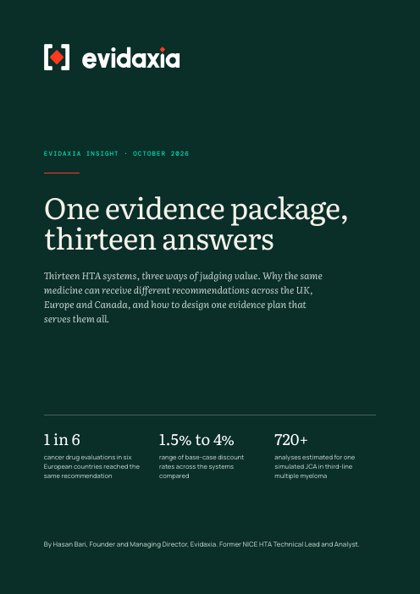
One evidence package, thirteen answers.
Our 21-page guide compares thirteen HTA systems across the UK, Europe and Canada, with 16 exhibits and full references. Subscribe to Evidaxia Briefing, our sourced analysis of market access, HTA decisions, evidence and health policy, and the guide downloads the moment you subscribe.
What discount rate does NCPE use compared with NICE?
NCPE assessments follow HIQA guidelines, which discount costs and outcomes at 4.0% a year after the first year. NICE, SMC and AWMSG use 3.5% a year in the base case.
How much does the Irish 4% discount rate change a cost-effectiveness result?
It depends on when benefits occur. In our worked example of 0.8 QALYs a year for 40 years, moving from 3.5% to 4% removed 6.9% of discounted QALYs; over five years the change was under 1%.
Which EQ-5D value set does NICE require?
The current NICE manual asks for the EQ-5D-3L value set, with 5L data mapped to 3L. NICE has consulted on adopting the new UK EQ-5D-5L value set for evaluations that start after its manuals are updated.
Is VAT included in an NCPE submission?
NCPE guidance excludes VAT from the cost-effectiveness analysis but includes it in the budget impact analysis, at the appropriate rate for the formulation.
What does an Irish budget impact analysis need?
HIQA guidelines ask for an HSE perspective, at least five years of undiscounted annual results, Irish epidemiology, explicit uptake and displacement assumptions with scenarios, and a fully executable model.
How should an adapted model be validated for NICE or NCPE?
Document quality assurance and validation as both agencies ask, using tools such as TECH-VER and AdViSHE, and add an adaptation log and a step-by-step reconciliation from the global to the local results.
Related analysis
Adapting a global model for the UK or Ireland? Let us check it first.
Start with a free, no-obligation 30-minute call with a senior consultant.