
Medicines access in Wales: a practitioner guide to NICE, AWMSG and the 2025 assessment process
Wales follows NICE for most new medicines, and the space around NICE is now larger and more structured, which gives launch plans more options. Since January 2025, AWMSG has offered a request-driven, routed process with three assessment types, its own commercial governance and a firm 60-day funding expectation once advice is ratified.
Two routes into one health service
For most new medicines, the route into NHS Wales runs through NICE. NICE guidance determines whether a medicine is recommended for NHS use in England and Wales, and when NICE issues a positive recommendation, health boards and the NHS Wales Joint Commissioning Committee are usually expected to make the medicine available within 60 days of NICE publishing Final Draft Guidance.[1] Welsh Government directions under the New Treatment Fund frame the same expectation as availability within no more than two months of publication of a NICE technology appraisal, a highly specialised technologies evaluation or a ratified AWMSG recommendation.[2]
The All Wales Medicines Strategy Group (AWMSG) has appraised medicines not covered by the NICE work programme, or where early appraisal is beneficial, since 2002.[1] What changed in January 2025 was the architecture around that remit. The revised process removed several previous exclusion criteria, opened requests for licensed medicines to NHS Wales healthcare professionals and patient organisations as well as marketing authorisation holders, and introduced a panel that routes each medicine to the assessment type it needs.[1]
Our overview of SMC and AWMSG sets Wales alongside Scotland. This guide goes deeper on Wales alone: mechanics, time windows, commercial governance and economic reporting conventions.
NICE route
- Applies to medicines on the NICE technology appraisal or highly specialised technologies work programme
- NICE guidance applies in England and Wales, for every type of NICE recommendation
- Commercial terms aligned with NHS England, with separate commercial engagement for Wales
- Standard NICE threshold range of £25,000 to £35,000 per QALY from April 2026
- Availability expected within 60 days of NICE Final Draft Guidance
AWMSG route
- Applies where NICE has not prioritised a medicine, NICE advice is terminated or not expected for some time, or NICE commercial terms do not apply in Wales
- Requests from companies, NHS Wales clinicians and patient organisations; routed to full HTA, interim HTA or limited assessment
- Commercial arrangements accepted by CASWG before the assessment proceeds
- Submission guidance asks for results at £20,000 and £30,000 per QALY; up to £100,000 per QALY for very rare diseases
- Availability no later than 60 calendar days after Welsh Government ratification
Sources: AWMSG process document (July 2026); AWTTC guidance notes (June 2025); AWMSG very rare disease policy (December 2025); NICE (December 2025).
When AWMSG appraises a licensed medicine
AWMSG will only consider a licensed medicine if there is a clearly identified clinical need or benefit to NHS Wales. The July 2026 process document sets out the criteria for a full health technology assessment: the medicine is likely to have a significant service or budget impact, and at least one of three conditions applies.[1]
- It is a new licensed medicine or licence extension not on the NICE technology appraisal or highly specialised technologies work programme, or NICE advice is not expected for a significant period.
- It has terminated NICE advice, or an AWMSG Statement of Advice issued because no company submission was made.
- The commercial arrangement that forms part of the NICE advice does not apply to NHS Wales.
The submission form is clear that NICE advice usually applies in NHS Wales, whatever form that advice takes, including terminated appraisals.[3] A medicine with an existing recommendation not to use it from NICE or AWMSG may be reassessed only if there are significant new factors showing added value or benefit to NHS Wales beyond the original assessment.[1] The guidance notes give examples of what that can look like: information specific to NHS Wales, such as a particular patient population or other societal benefit, or a commercial arrangement in the form of a Wales Patient Access Scheme (WPAS) or Commercial Access Agreement (CAA).[4]
Off-label medicines and the One Wales route
Off-label use follows a parallel route through the One Wales Medicines Assessment Group (OWMAG). Requests come from NHS Wales healthcare professionals and patient organisations, routes include health board Individual Patient Funding Request (IPFR) panels, and requests from pharmaceutical companies are not accepted. Assessment is driven by unmet need identified by clinicians.[5] OWMAG recommendations are interim and are reviewed after the first 12 months, then every one to three years.[6] For companies, a One Wales recommendation can shape the pathway, and the comparator, that a later licensed submission meets.
Routing: one panel and three assessment types
The January 2025 process introduced the AWMSG Scrutiny Panel, with NHS Wales and lay membership, to decide whether AWMSG should proceed, to prioritise requests and to select the route using predefined criteria; the Licensed One Wales Medicines Assessment Group (LOWMAG) replaced the New Medicines Group for licensed medicines.[7] It works from an AWTTC proforma covering the evidence base, place in the pathway, comparators and estimated budget and service impact.[1]
- IdentificationCompany, clinician or patient organisation request, or AWTTC horizon scanning
- AWTTC proformaEvidence base, pathway, comparators, budget and service impact
- Panel decisionSuitability and route, endorsed by the AWMSG Steering Committee
- Applicant response10 working days to appeal the routing decision
- Full HTAClinical and cost-effectiveness assessment for significant impact
- Interim HTA or limited assessmentTime-limited advice with data collection, or a focused review
- Other outcomesOWMAG for off-label use, deferral, or local access routes
Interim HTA may be considered for medicines that meet the full HTA criteria where data collection is needed to reduce uncertainty about comparative clinical and cost-effectiveness, and the company commits to an updated submission to AWMSG or NICE once data are collected. A commercial arrangement to supply the medicine at reduced cost is required so that risk is shared between the company and NHS Wales, and interim outcomes are time limited and regularly reviewed.[1] The guidance notes add that interim HTA is suited to a notably high level of unmet need where no suitable alternative is available.[4]
Limited assessment is likely where all-Wales advice is clearly needed, the medicine and indication are not on the NICE work programme and no significant service impact is expected, and at least one of the following applies: a small net budget impact or cost saving, inclusion in national guidelines, standard-of-care status, national commissioning advice elsewhere in the UK, or significant service delivery benefit.[1] The limited assessment form is correspondingly compact, covering clinical effectiveness or equivalence, costs, patient eligibility, a five-year budget impact and equity considerations.[8]
The published decision records show how the Panel uses these routes. Across 15 meetings between January 2025 and August 2026, it recorded 36 decisions.[9]
- Limited assessment (LOWMAG)12
- Off-label assessment (OWMAG)12
- Not taken forward for all-Wales assessment7
- Full HTA (LOWMAG)4
- Deferred for further information1
Source: AWTTC published panel decision records; Evidaxia count of 36 published decisions. Bar length is relative to the largest category.
In our experience, this distribution is a useful signal of how Wales now works. Limited assessment and off-label assessment each account for a third of decisions, while full HTA is used selectively. The published rationales for limited assessment cite small eligible populations, low budget impact and established guideline positions, so evidence of those features supports a request for a proportionate route.
Inside the assessment: windows, documents and roles
Once a route is agreed, the company completes the HTA or limited assessment form. The assessment proceeds only once a submission has been received, scope and timelines have been agreed with AWTTC, and any commercial arrangement has been confirmed.[1] AWTTC then prepares an evidence summary report (ESR) that summarises and critiques the evidence, draws on clinicians for patient numbers, place in therapy and comparators, and invites patient organisations to describe unmet need and impact on quality of life.[1]
- Panel decision10 working days to appeal the route
- Scope and commercialsScope agreed and CASWG acceptance before timelines are set
- Company response10 working days for the CR-ESR table
- LOWMAGRecommendation and rationale shared with the company for comment
- AWMSG endorsement10 days for comments or an Independent Review request
- Welsh GovernmentRatifies the endorsed recommendation
- AvailabilityNo later than 60 calendar days after ratification
Source: AWMSG Licensed One Wales Medicines Assessment Process, July 2026. AWTTC does not publish a fixed end-to-end duration; windows shown are those stated in the process document.
The company response and LOWMAG
Companies that have submitted complete a company response to the ESR (CR-ESR) table, in which AWTTC may raise queries and the company can correct factual inaccuracies. No additional clinical or economic evidence is included at this stage unless agreed with AWTTC, and the 10 working day window does not pause the process if no response is received.[1] In our experience, this makes the original submission decisive: the CR-ESR is for clarification, not rebuilding.
LOWMAG meets in private, monthly or as needed. Its membership includes NHS Wales healthcare professionals, industry representatives and lay members, and it reaches recommendations by consensus or majority vote. For company-initiated appraisals, the company is invited to send typically two representatives, one with clinical knowledge and one with cost-effectiveness knowledge, to observe, contribute and answer questions; they leave before the decision is made, and before any discussion of confidential comparator costs.[1]
Recommendation categories
| Group | Possible recommendations | Review |
|---|---|---|
| LOWMAG (licensed) | Recommended; recommended with restrictions; recommended on an interim basis; not recommended; or deferral pending information | When significant new evidence emerges; interim outcomes time limited |
| OWMAG (off-label) | Recommended; recommended with restricted use; not recommended; or deferral | After 12 months, then every one to three years |
Sources: AWMSG process document; AWTTC sub-groups page.[1, 6]
LOWMAG can also propose an interim positive recommendation where the evidence does not support full advice, but the company must agree before it goes forward; if it does not, LOWMAG makes a new decision.[1] If an interim recommendation is later withdrawn because no updated submission is made, people already on treatment may continue until they and their clinician decide to stop.[1]
Endorsement, review and ratification
AWMSG is asked to endorse each recommendation and confirm that the appraisal was thorough and consistent. If it does not endorse, it must state its reasons and return the recommendation to LOWMAG.[1] The originator of the assessment can request an Independent Review on how the assessment was conducted or how scientific information was interpreted, and ratification is postponed while the request is considered.[1] The Independent Review policy, updated in June 2026, specifies a request within two weeks of the AWMSG meeting and notes that a review is intended for procedural matters rather than the outcome itself; significant new information is treated as a new application.[10]
After ratification, AWTTC publishes the decision rationale, ESR, minutes and Equality and Health Impact Assessment, with commercially sensitive information redacted.[1] AWMSG advice is usually superseded by any later NICE guidance for the same medicine and indication, but continues to stand if NICE terminates its appraisal.[1]
Statements of Advice in the 2025 process
The Statement of Advice has changed character. Under the current process, the AWMSG Steering Committee may recommend one where an assessment was initiated by a company, the Panel judged assessment appropriate, and progress then paused because the company did not continue to engage. It notifies that the medicine is not endorsed for routine use in NHS Wales and is ratified by Welsh Government.[1]
For assessments that a company did not initiate, the position is different. Companies are under no obligation to submit, the assessment proceeds regardless of their involvement, and where a medicine is a high priority the Steering Committee may direct that it proceed on publicly available information.[1] AWTTC's earlier review of Statements of Advice issued between January 2015 and September 2020 examined the reasons for non-engagement and informed later process updates.[11]
Two further points matter for planning. Healthcare professionals can request review of a Statement of Advice where unmet need for all-Wales advice exists, and a medicine with a Statement of Advice now meets one of the criteria for full HTA.[1] In our experience, a Statement of Advice is best read as a pause in the evidence conversation rather than an endpoint.
The 2025 process means a medicine can come to AWMSG whether or not its company asks. The opportunity is to shape that assessment with Welsh data and a workable commercial offer, from the very start.
Commercial arrangements: CASWG, CMAT and alignment with England
A commercial arrangement in Wales can be a Patient Access Scheme (PAS) or a Commercial Access Agreement (CAA). Approval is governed by the Commercial Arrangement Scheme Wales Group (CASWG), an AWMSG sub-committee, and implementation is supported by the Commercial Medicines Access Team (CMAT), drawn from AWTTC, NHS Wales Shared Services Partnership and the Medicines Value Unit. For NICE-evaluated products, NHS Wales aligns commercial agreements with NHS England, but separate commercial engagement for Wales is still required.[12] For NICE-route medicines, a PAS is considered after positive advice from the Patient Access Scheme Liaison Unit, Department of Health approval and incorporation into positive NICE Final Draft Guidance; for Welsh arrangements, after positive CASWG advice and Welsh Government approval.[4]
For AWMSG assessments, sequencing is explicit. Companies with an existing arrangement confirm whether it extends to the indication; companies without one may be invited to consider a simple scheme; and an assessment proceeds, with timelines agreed, only once CASWG has accepted the arrangement. Any arrangement must be in place before the medicine can be routinely prescribed.[1]
Source: AWMSG annual report 2025-2026.
The annual report for 2025-26, the first full year of the updated process, breaks those 58 recommendations down as 41 simple PAS (71%), 16 complex CAAs (28%) and one highly complex CAA, with 16 contract variations processed. It records nine medicines assessed by LOWMAG and OWMAG, plus one through the previous process, and seven off-label medicine reviews.[13] A year earlier, 55 commercial access lines were 75% simple PAS, 15% complex CAA and 10% highly complex CAA.[14] For teams planning managed access or outcomes-based agreements, complex arrangements are now a routine part of the Welsh portfolio, and early CMAT engagement supports realistic implementation timelines.
Economic evidence: what AWMSG asks for
AWMSG's economic requirements are close to NICE methods, with distinct Welsh features. The costing perspective is the NHS in Wales and personal social services. Costs and benefits are discounted at 3.5% a year, with 1.5% potentially acceptable in a justified scenario where a medicine restores people to near-full health with long-sustained benefits.[4] Wales-specific data are expected: data from other UK countries, or elsewhere, will not be accepted where Wales-specific data are available.[4]
Reporting at £20,000 and £30,000 per QALY
The current guidance notes, dated June 2025, ask companies to present the probability of being cost-effective at willingness-to-pay values of £20,000 and £30,000 per QALY, and to calculate net health benefit at both values, with and without any decision modifier weighting.[3, 4] NICE's standard range moved to £25,000 to £35,000 per QALY from April 2026, applied to new and ongoing appraisals.[15] AWMSG's December 2025 minutes record the NICE change.[16] At the time of writing, the industry forms page still lists the June 2025 guidance notes and we have not found a published AWMSG statement adopting a new range.[17] Because NICE guidance applies in Wales, the new NICE range already shapes NICE-route recommendations for NHS Wales.
Sources: AWTTC HTA guidance notes (June 2025); NICE (December 2025). AWMSG's very rare disease policy usually allows up to £100,000 per QALY.
Severity and very rare diseases
AWMSG endorsed a severity modifier in July 2022 to align with NICE. QALY weights of 1.2 or 1.7 apply according to absolute shortfall (12 to 18, or 18 or more) or proportional shortfall (0.85 to 0.95, or 0.95 or more), with the more severe measure taking precedence and a 3.5% discount rate used for shortfall estimates.[18] AWTTC states in the ESR whether it considers the modifier applicable, and the company can respond in the CR-ESR and at the LOWMAG meeting.[18]
The very rare disease policy requires all four criteria: a point prevalence of 1 in 50,000 or less in Wales (approximately 63 people or fewer); an innovative, first licensed treatment rather than a repurposed one; no more than 18 eligible people in Wales; and likely substantial additional benefit where existing management is inadequate. LOWMAG may then consider a threshold usually up to £100,000 per QALY, with QALY weights from 1 to 3 according to lifetime incremental QALYs per patient (10 or fewer: 1; 30 or more: 3). No severity weight is added on top. A Clinician and Patient Involvement Group (CAPIG) meeting can follow a LOWMAG recommendation not to use the medicine, extending the process by up to 12 weeks.[19]
Worked example: net health benefit with a modifier
Net health benefit is NHB = incremental QALYs − (incremental cost ÷ value per QALY). Illustrative figures only: a medicine with an incremental cost of £24,000 and 1.0 incremental QALY per patient.
- At £20,000:
1.0 − 1.2 = −0.2QALYs. At £30,000:1.0 − 0.8 = +0.2QALYs. - With a severity weight of 1.2, weighted QALYs are 1.2. At £20,000:
1.2 − 1.2 = 0.0. At £30,000:1.2 − 0.8 = +0.4.
Presenting weighted and unweighted values shows where the decision turns. The guidance notes highlight net health benefit as particularly useful when a decision modifier applies or QALY differences are small.[4]
Budget impact: a five-year Welsh view
Budget impact is central to routing as well as appraisal, because "significant impact" points towards full HTA and "small net budgetary impact" towards limited assessment.[1] The documents we reviewed do not set a numerical budget threshold for this distinction. Both submission forms require the Excel-based AWTTC budget impact template, with net acquisition costs and net resource implications for each of the first five years after introduction.[3, 8] Prevalence, incidence, eligibility, uptake and discontinuation should be estimated for Wales; UK data may be adapted using Welsh population statistics only where Welsh data are not readily available.[4]
Where comparators have an approved confidential arrangement, companies should test discounts from 5% to 95% in 5% steps and include a discount field accepting any value from 0% to 100%.[4] Equity, wider societal costs and benefits, and environmental impacts are also requested.[4] Our budget impact modelling work is built around these Welsh conventions from the outset.
Funding and implementation
Implementation in Wales is supported by the New Treatment Fund, launched in January 2017.[14] Senedd Research reports that it provides £16 million a year and that the average time to make a medicine available is now 16 days.[20] The directions allow only limited exemptions from the two-month expectation, such as an extended implementation period confirmed by NICE, recommended by AWMSG or determined by Welsh ministers.[2] Clinicians may be asked to complete Blueteq forms at initiation and review, and LOWMAG may require outcome monitoring, especially for interim recommendations.[1] AWTTC's annual report sets the end of March 2027 as the deadline for full Blueteq roll-out across health boards and trusts.[13]
Activity has also shifted. Senedd Research notes that AWMSG appraised 47 medicines in 2015-16, 17 in 2022-23 and five licensed medicines in 2024-25, attributing the change to NICE's 2022 approach to technology appraisals.[20] The 2025 process focuses AWMSG on the gaps NICE does not reach, with a broader set of tools.
What this means for evidence planning
- Confirm NICE status earlyWork programme position, expected timing and whether NICE commercial terms will apply in Wales
- Map the likely routeFull HTA, interim HTA or limited assessment, using the published criteria and decision records
- Build Welsh epidemiologyPrevalence, incidence and eligibility for Wales, so the budget impact rests on local data
- Prepare the commercial proposal in parallelCASWG acceptance sets the start of the assessment timeline
- Configure the model for AWMSGNHS Wales and PSS perspective, £20,000 and £30,000 outputs, net health benefit and a comparator discount field
- Assess modifier eligibilitySeverity shortfall or very rare disease criteria, documented before submission
- Engage Welsh clinicians and patient groupsThey inform patient numbers, comparators and the patient perspective in the ESR
- Plan for the 10 working day windowsA complete submission makes the CR-ESR a clarification step
How Evidaxia can help
Evidaxia supports AWMSG submissions across full HTA, interim HTA and limited assessment, including route assessment, Welsh budget impact models, adaptation of NICE models to AWMSG conventions and preparation for LOWMAG. See our AWMSG submissions service and UK HTA submissions, and read our guides to NICE technology appraisal in 2026 and SMC submissions in Scotland. To discuss a Welsh access plan, contact us.
References
- All Wales Medicines Strategy Group. The AWMSG Licensed One Wales Medicines Assessment Process [Internet]. Cardiff: All Wales Therapeutics and Toxicology Centre; 2026 Jul [cited 2026 Nov 1]. Available from: https://awttc.nhs.wales/accessing-medicines/medicines-assessment-policy-documents/the-awmsg-licensed-one-wales-medicines-assessment-process/
- Welsh Government. New Treatment Fund: directions on the exemptions for health boards and trusts (WHC/2024/020) [Internet]. Cardiff: Welsh Government; 2024 [cited 2026 Nov 1]. Available from: https://www.gov.wales/node/61600
- All Wales Therapeutics and Toxicology Centre. Submission form for AWMSG health technology assessment [Internet]. Cardiff: All Wales Therapeutics and Toxicology Centre; 2025 Jun [cited 2026 Nov 1]. Available from: https://awttc.nhs.wales/accessing-medicines/pharmaceutical-industry/industry-submission-forms-new-process/hta-submission-form-final-june-2025/
- All Wales Therapeutics and Toxicology Centre. Guidance notes for the submission form for AWMSG health technology assessment [Internet]. Cardiff: All Wales Therapeutics and Toxicology Centre; 2025 Jun [cited 2026 Nov 1]. Available from: https://awttc.nhs.wales/accessing-medicines/pharmaceutical-industry/industry-submission-forms-new-process/hta-submission-form-guidance-notes-final-june-2025/
- All Wales Therapeutics and Toxicology Centre. 1: Identifying medicines for AWMSG assessment [Internet]. Cardiff: All Wales Therapeutics and Toxicology Centre; [date unknown] [cited 2026 Nov]. Available from: https://awttc.nhs.wales/accessing-medicines/awmsg-medicines-assessment-process-for-licensed-and-off-label-medicines/1-identifying-medicines-for-awmsg-assessment/
- All Wales Therapeutics and Toxicology Centre. 4: AWMSG sub-groups [Internet]. Cardiff: All Wales Therapeutics and Toxicology Centre; [date unknown] [cited 2026 Nov]. Available from: https://awttc.nhs.wales/accessing-medicines/awmsg-medicines-assessment-process-for-licensed-and-off-label-medicines/4-awmsg-sub-groups/
- All Wales Therapeutics and Toxicology Centre. Updated AWMSG medicine assessment process to launch in January 2025 [Internet]. Cardiff: All Wales Therapeutics and Toxicology Centre; 2024 Nov 14 [cited 2026 Nov 1]. Available from: https://awttc.nhs.wales/news-meetings-and-events/news1/updated-awmsg-medicine-assessment-process-to-launch-in-january-2025/
- All Wales Therapeutics and Toxicology Centre. Submission for AWMSG limited assessment form [Internet]. Cardiff: All Wales Therapeutics and Toxicology Centre; 2025 Jun [cited 2026 Nov 1]. Available from: https://awttc.nhs.wales/accessing-medicines/pharmaceutical-industry/industry-submission-forms-new-process/limited-assessment-form-final-june-2025/
- All Wales Therapeutics and Toxicology Centre. AWMSG Scrutiny Panel decisions [Internet]. Cardiff: All Wales Therapeutics and Toxicology Centre; [date unknown] [cited 2026 Nov]. Available from: https://awttc.nhs.wales/accessing-medicines/awmsg-scrutiny-panel-decisions/
- All Wales Medicines Strategy Group. The AWMSG Independent Review (IR) Process [Internet]. Cardiff: All Wales Therapeutics and Toxicology Centre; 2026 Jun [cited 2026 Nov 1]. Available from: https://awttc.nhs.wales/accessing-medicines/medicines-assessment-policy-documents/the-awmsg-independent-review-process/
- All Wales Therapeutics and Toxicology Centre. AWTTC reports on Statements of Advice (SOAs) issued by the All Wales Medicines Strategy Group (AWMSG) [Internet]. Cardiff: All Wales Therapeutics and Toxicology Centre; 2022 Oct [cited 2026 Nov 1]. Available from: https://awttc.nhs.wales/news-meetings-and-events/news1/awttc-reports-on-statements-of-advice-soas-issued-by-the-all-wales-medicines-strategy-group-awmsg/
- All Wales Therapeutics and Toxicology Centre. Submit a commercial arrangement to the NHS in Wales [Internet]. Cardiff: All Wales Therapeutics and Toxicology Centre; [date unknown] [cited 2026 Nov]. Available from: https://awttc.nhs.wales/accessing-medicines/submit-a-commercial-arrangement-to-the-nhs-in-wales/
- All Wales Medicines Strategy Group. AWMSG annual report 2025-2026 [Internet]. Cardiff: All Wales Therapeutics and Toxicology Centre; 2026 Sep [cited 2026 Nov 1]. Available from: https://awttc.nhs.wales/files/awmsg/awmsg-annual-reports/awmsg-annual-report-2025-2026/
- All Wales Medicines Strategy Group. AWMSG annual report 2024-2025 [Internet]. Cardiff: All Wales Therapeutics and Toxicology Centre; 2025 [cited 2026 Nov 1]. Available from: https://awttc.nhs.wales/files/awmsg/awmsg-annual-reports/awmsg-annual-report-2024-2025/
- National Institute for Health and Care Excellence. Changes to NICE's cost-effectiveness thresholds confirmed [Internet]. London: National Institute for Health and Care Excellence; 2025 Dec 1 [cited 2026 Nov 1]. Available from: https://www.nice.org.uk/news/articles/changes-to-nice-s-cost-effectiveness-thresholds-confirmed
- All Wales Medicines Strategy Group. Draft minutes of the AWMSG meeting, 2 December 2025 [Internet]. Cardiff: All Wales Therapeutics and Toxicology Centre; 2025 [cited 2026 Nov 1]. Available from: https://awttc.nhs.wales/files/awmsg-meetings/enc-1-draft-minutes-awmsg-2-dec-25/
- All Wales Therapeutics and Toxicology Centre. Industry submission forms (new process) [Internet]. Cardiff: All Wales Therapeutics and Toxicology Centre; [date unknown] [cited 2026 Nov]. Available from: https://awttc.nhs.wales/accessing-medicines/pharmaceutical-industry/industry-submission-forms-new-process/
- All Wales Medicines Strategy Group. Policy for appraising medicines for severe conditions [Internet]. Cardiff: All Wales Therapeutics and Toxicology Centre; 2025 Dec [cited 2026 Nov 1]. Available from: https://awttc.nhs.wales/accessing-medicines/medicines-assessment-policy-documents/awmsg-policy-severity-modifier-final-december-2025-pdf/
- All Wales Medicines Strategy Group. Policy for appraising a medicine for a very rare disease [Internet]. Cardiff: All Wales Therapeutics and Toxicology Centre; 2025 Dec [cited 2026 Nov 1]. Available from: https://awttc.nhs.wales/accessing-medicines/medicines-assessment-policy-documents/medicines-for-very-rare-diseases-policy-2025-final-december-2025-pdf/
- Senedd Research. Access to new medicines in Wales [Internet]. Cardiff: Senedd Research; 2025 Dec [cited 2026 Nov 1]. Available from: https://research.senedd.wales/media/moyhta3u/access-to-new-medicines-in-wales-research-briefing.pdf
Sources accessed October 2026. This article is analysis for information and is not legal, regulatory or tax advice.
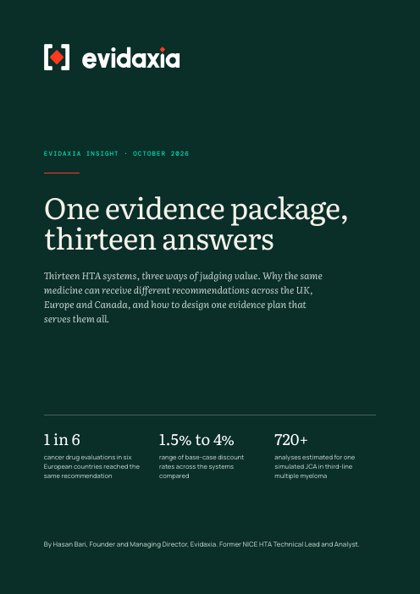
One evidence package, thirteen answers.
Our 21-page guide compares thirteen HTA systems across the UK, Europe and Canada, with 16 exhibits and full references. Subscribe to Evidaxia Briefing, our sourced analysis of market access, HTA decisions, evidence and health policy, and the guide downloads the moment you subscribe.
Does NICE guidance apply in Wales?
Yes. NICE guidance applies in England and Wales, for every type of NICE recommendation, and health boards are usually expected to make NICE-recommended medicines available within 60 days of Final Draft Guidance.
When does AWMSG appraise a licensed medicine?
Where there is clinical need or benefit to NHS Wales and the medicine is not on the NICE work programme, NICE advice is terminated or not expected for some time, a Statement of Advice exists, or NICE commercial terms do not apply in Wales.
What are the AWMSG assessment routes?
An AWMSG panel routes licensed medicines to full HTA, interim HTA with data collection and a commercial arrangement, or a limited assessment for low budget impact or established medicines. Off-label use goes to OWMAG.
What cost-effectiveness values does AWMSG use?
The June 2025 guidance notes ask for the probability of cost-effectiveness and net health benefit at £20,000 and £30,000 per QALY. The very rare disease policy usually allows up to £100,000 per QALY.
What is a Statement of Advice from AWMSG?
A notification, ratified by Welsh Government, that a medicine is not endorsed for routine use in NHS Wales, issued where a company-initiated assessment pauses because the company does not continue to engage. Clinicians can request review where unmet need exists.
How long after AWMSG advice is a medicine available in Wales?
Once Welsh Government ratifies a positive recommendation, and the medicine is launched with any commercial arrangement in place, it should be available no later than 60 calendar days after ratification.
Related analysis
Planning access in Wales? Map your AWMSG route alongside your NICE timeline.
Start with a free, no-obligation 30-minute call with a senior consultant.