
PICO scoping in the EU joint clinical assessment: how it works, what the first reports show, and how to prepare
The assessment scope is fixed before most of the dossier is written, and it decides which comparisons a company must evidence. This article explains how JCA PICO scoping works under the HTA Regulation and its implementing act, what the first published reports show, and how to prepare an evidence programme that can respond within the deadline.
Why scoping is the decisive step
Under Regulation (EU) 2021/2282, the joint clinical assessment (JCA) describes the relative effects of a health technology on health outcomes and the certainty of those effects. It deliberately stops short of value judgements: the report "shall not contain any value judgement or conclusions on the overall clinical added value"[1]. Everything the report can say is therefore bounded by the assessment scope, which Article 8(6) requires to be "inclusive and reflect Member States' needs" in terms of patient population, intervention, comparators and health outcomes[1].
The practical consequence is that the scope, expressed as a set of PICO questions, determines the analyses the health technology developer (HTD) must supply. It is agreed by the Member States, not by the company, and it is finalised only a short time before the dossier clock starts. A company that waits for the scope before planning its evidence will, in our experience, find it harder to deliver a complete dossier on time.
The JCA obligation has applied since 12 January 2025 to oncology medicines with new active substances and to advanced therapy medicinal products. It extends to designated orphan medicines from 13 January 2028 and to all other centrally authorised medicines in scope from 13 January 2030[1].
The legal framework: what the implementing act requires
The procedural detail sits in Commission Implementing Regulation (EU) 2024/1381, adopted on 23 May 2024[2]. The sequence for a medicinal product is as follows.
- Information at filing: When the HTD files with the European Medicines Agency, it provides the HTA secretariat with the proposed summary of product characteristics and the clinical overview (Article 2). The secretariat may invite the HTD to provide further scoping information in writing or at a meeting[2].
- Scope proposal: The assessor, with the co-assessor, prepares an assessment scope proposal and may seek patient, clinical expert and other expert input (Article 9(1))[2].
- Member State input and consolidation: The proposal is shared with members of the JCA subgroup; the assessor then prepares a consolidated proposal reflecting Member State needs, which is shared with selected patients and experts for input (Article 9(2) and (3))[2].
- Finalisation: The JCA subgroup discusses the consolidated proposal at a scope consolidation meeting. The scope is finalised at the latest 10 days after the Committee for Medicinal Products for Human Use (CHMP) adopts its list of questions, or within 75 days of validation for accelerated assessments and certain variations (Article 10)[2].
- Explanation meeting: On request, the HTD is invited to an assessment scope explanation meeting, held no later than 20 days after the scope is finalised (Article 11)[2].
- Dossier: The HTD must submit the dossier within 100 days of notification of the Commission's first request, which carries the finalised scope. The period is 60 days for accelerated procedures and certain variations (Article 12(2))[2].
- Missing information: If the dossier is incomplete, the HTD has 15 days from the second request to supply the missing information, shortened to 10 days in accelerated cases and 7 days where only minor information is missing (Article 12(4))[2].
The 100-day clockThe final implementing act sets the dossier deadline as 100 days from notification of the first request, not as a number of days before the CHMP opinion. The revised draft reports must then be finalised at the latest on the date of the Commission decision granting marketing authorisation[2].
Three features of this design matter for planning. First, the HTD informs the scope but does not draft it. Second, the scope can only be discussed with the assessors after it is final. Third, the 100-day window has to accommodate any new analyses, including indirect comparisons for comparators the company may not have anticipated.
How the Coordination Group guidance consolidates Member State needs
The HTA Coordination Group (HTACG) adopted its Guidance on the scoping process on 28 November 2024[3]. It describes four steps: an assessor and co-assessor proposal, a PICO survey sent to all Member States through the HTA IT platform, consolidation by the assessors, and finalisation by consensus in the JCA subgroup. The stated aim of consolidation is that "MS needs are translated in the lowest possible number of PICOs"[3].
The guidance sets out several rules that drive the shape of the final scope[3]:
- Populations: Subpopulations receive separate PICOs when different comparators apply, when the indication names distinct subpopulations, or when prognoses differ. Subgroup analyses do not create new PICOs.
- Comparators: Naming "standard of care" is not sufficient; its components must be specified. Best supportive care and watchful waiting can be comparators or components of one.
- Comparator scenarios: A Member State may require one treatment, several treatments each separately, at least one of several treatments (joined by "OR" within a single PICO), or an individualised treatment comparator, which bundles options chosen according to patient characteristics.
- Merging: Treatments already covered by another PICO can be dropped unless a Member State objects. A PICO is retained where any Member State requires it and has said it cannot be dropped. Individualised treatment comparators cannot be merged with "several treatments" scenarios and therefore always form a separate PICO.
- Outcomes: Outcomes are listed for every PICO and are not ranked.
The guidance's own worked example consolidates the requests of five hypothetical Member States into seven PICOs[3]. The HTACG's question-and-answer document adds that the HTD cannot propose an indication different from the one claimed with the EMA, and that a company which disagrees with a PICO is still "required to address all PICOs appropriately in the dossier"[4].
Why the number of PICOs can be large
An inclusive scope across health systems with different treatment pathways will, almost by construction, generate several PICOs. A simple way to see this is to treat the scope as the sum, over populations, of the comparator sets that cannot be merged:
Number of PICOs = sum over populations p of (number of non-mergeable comparator sets in p)
Consider a hypothetical second-line indication in which Member States ask for three populations: the full indication, a biomarker-positive subgroup and a biomarker-negative subgroup. In the full indication, some countries need chemotherapy A, others need chemotherapy B and one requires an individualised treatment comparator. If one country insists that A and B must each be shown separately, the full indication alone yields three PICOs. Add one targeted therapy for the biomarker-positive subgroup and two non-mergeable options for the biomarker-negative subgroup, and the scope has six PICOs before any outcome is considered. Each PICO then needs every outcome in the scope, and the subgroup analyses that apply to it.
Published simulations point in the same direction. A review by authors from one HTD of 14 publications, covering 35 PICO exercises across 20 indications (74% oncology), found an average of 7 participating countries and 8 consolidated PICOs per exercise. A separate simulation of a first-line immuno-oncology therapy in metastatic non-small cell lung cancer, reflecting 25 countries, generated 67 PICOs, largely driven by biomarker and histology subpopulations[5]. An independent analysis of onco-haematological medicines licensed between January 2023 and April 2025 found that a simulated scoping exercise produced at least four PICOs per medicine, and that the evidence available at marketing authorisation was insufficient to address all of them[6]. Simulations cannot predict a real consolidation, but they indicate the scale companies should be ready for.
What the published JCA reports show
The Commission published the first JCA report, on tovorafenib (Ojemda) for paediatric low-grade glioma, on 9 June 2026. At that point 18 JCAs had been initiated since January 2025[7]. By September 2026 the Commission's tracker listed four completed JCAs, and its October 2026 extraction listed 19 assessments as ongoing[8]. Three reports are summarised below from the Commission's own summary reports.
| Report | PICOs in scope | Evidence used | Points to note |
|---|---|---|---|
| Tovorafenib, paediatric low-grade glioma (assessor NCPE, co-assessor IQWiG)[8, 9] | 8, across three populations | Single-arm phase 2 study; one unanchored matching-adjusted indirect comparison (MAIC) for PICO 5 | No direct comparative data for any PICO; one PICO excluded for insufficient information on the comparator study; effective sample size 5.81 to 14.26 |
| Tarlatamab, extensive-stage small cell lung cancer (assessor IQWiG, co-assessor Hungary)[8, 10] | 7, across four populations | Direct RCT comparison for three PICOs; unanchored MAIC; Bayesian network meta-analysis (NMA); Bucher comparisons | Similarity assumption judged severely violated in the NMAs; some PICOs lacked safety or subgroup results |
| Lurbinectedin, extensive-stage small cell lung cancer maintenance (assessor IQWiG, co-assessor Portugal)[8, 11] | 1 | Direct comparison from a phase 3 RCT | Results reported at the last prespecified data cut-off; p-values nominal |
Several lessons are visible. In the tovorafenib report, the assessors concluded that "no direct comparative data are available to inform any of the PICOs", and that anchored indirect comparisons were not possible because no connected network existed[9]. The only comparative analysis was an unanchored MAIC, which the report treated as non-randomised evidence with a greater risk of bias. The effective sample size fell to between 5.81 and 14.26 after weighting, indicating poor covariate overlap[9]. The effective sample size of a weighted sample is:
ESS = (sum of weights)^2 / (sum of squared weights)
When a small number of patients carry most of the weight, ESS collapses, and any comparison becomes imprecise however the point estimate looks.
The tarlatamab report shows the opposite problem: a well-populated scope, in which each PICO drew on a different analytical route. For the network meta-analyses, the assessors judged the similarity assumption across studies to be severely violated and rated certainty as very low; the networks had no closed loops, so consistency could not be assessed. For the unanchored MAIC, only 4 of 10 identified covariates were adjusted for[10]. The lurbinectedin report, with a single PICO matching the randomised comparison in the pivotal trial, was the most straightforward of the three[11].
The tracker also records what happens when the dossier falls short. By September 2026 four JCAs had been discontinued: one after withdrawal of the marketing authorisation application and three because the dossier failed to meet the requirements of Article 9(2), (3) and (4) of the Regulation[8]. Discontinuation does not affect the marketing authorisation timeline, but it removes the joint report that Member States would otherwise use.
Our readingThe first reports suggest that the number of PICOs matters less than whether each PICO can be answered with a defensible comparison. A single, well-matched randomised comparison produced a clear report. Wide scopes populated by unanchored or poorly connected comparisons produced reports dominated by statements about uncertainty.
Implications for evidence generation and indirect comparisons
The HTACG methodological guideline on direct and indirect comparisons, adopted on 8 March 2024, is explicit that "anchored indirect comparisons preserve randomisation and should always be used in preference to unanchored methods"[12]. It describes unanchored MAIC and simulated treatment comparison without a common comparator as "highly problematic", notes that the Bucher method is limited to simple star networks in which consistency cannot be tested, and states that multilevel network meta-regression, as currently proposed, cannot be applied to time-to-event data[12]. For population-adjusted or non-randomised estimates, it describes testing against a shifted null hypothesis, while leaving the threshold to Member States[12, 13].
These positions are consistent with the NICE Decision Support Unit recommendations on population adjustment, which state that an anchored comparison should always be preferred in a connected network and that unanchored comparisons require adjustment for all effect modifiers and prognostic variables[14]. The difference under JCA is one of scale: the same standards are applied PICO by PICO, across comparators that matter to different health systems.
Four implications follow for clinical development and evidence planning:
- Comparator choice in pivotal trials: A randomised comparison against a comparator that many Member States use will address several PICOs at once. The lurbinectedin report illustrates the value of that alignment[11]. Joint scientific consultations exist for this purpose; the Commission describes them as a way to "streamline evidence preparation for JCA"[15].
- Network connectivity: Where the pivotal trial is single-arm, every PICO becomes either an unanchored comparison or an evidence gap. Where a trial has an active control, planning which trials connect it to likely national comparators should begin well before filing.
- Individual patient data: Population adjustment requires individual patient data from at least one study, and the guideline notes that MAIC and STC should not be used when full individual patient data are available for all studies[13].
- Outcomes and data cut-offs: The HTACG outcomes guidance prefers final patient-centred outcomes and describes a trial-level correlation of at least 0.85 as "high" for surrogate validation[16]. The Q&A requires results at the most recent prespecified data cut-off and, for overall survival, the last available cut if it differs[4].
Implications for systematic literature review design
The JCA dossier depends on systematic reviews in two ways: to identify every study relevant to each PICO, and to identify covariates for any adjusted comparison. The practical guideline states that a rigorous systematic review "is a prerequisite" for evidence synthesis[13]. The Q&A adds three requirements that shape review design[4]:
- a systematic literature review is required to identify covariates, although an existing high-quality review of prognostic factors and effect modifiers may suffice;
- searches for relative effectiveness and safety evidence must have a cut-off no more than three months before dossier submission;
- all available evidence must be included in the initial dossier, and any unaddressed item must be justified.
Together, these point towards a broad, PICO-agnostic review that is designed before the scope is known and refreshed close to submission. In practice that means eligibility criteria wide enough to capture every plausible comparator across the EU, including older regimens still used in some systems, and a protocol that anticipates a rapid update. The HTACG guidance on study validity recommends the Cochrane RoB 1 instrument for randomised trials, describing it as currently "preferable over the RoB 2 tool", and ROBINS-I for non-randomised studies[17]. Review teams used to RoB 2 for other agencies should plan for this.
Subgroup analyses also need planning. The Q&A states that all outcomes in the scope should be included in requested subgroup analyses, and that a subgroup analysis is required only where each subgroup includes at least 10 people and, for binary or time-to-event data, at least 10 events in one subgroup[4].
A practical preparation framework
We use a five-stage framework to prepare for scoping. It is our own approach, not an HTACG requirement, and it is intended to make the 100-day window a period of execution rather than discovery.
| Stage | Timing (indicative) | Main outputs |
|---|---|---|
| 1. Landscape and treatment-pathway mapping | Phase 2 to pivotal trial design | Country-by-country comparators, guidelines and reimbursed options; input to joint scientific consultation |
| 2. PICO simulation | 12 to 18 months before filing | Simulated Member State requests consolidated with the HTACG rules into a range of plausible scopes, including individualised treatment scenarios |
| 3. Evidence matrix and feasibility | 9 to 12 months before filing | For each simulated PICO and outcome: data source, analytical route (direct, anchored, population-adjusted, unanchored, gap) and expected certainty |
| 4. Pre-built analysis infrastructure | Before filing | Broad SLR with update protocol; covariate review; prespecified ITC statistical analysis plans; validated code for each method; subgroup shells |
| 5. Scope response | From scope finalisation to dossier submission | Explanation meeting questions; mapping of the final scope to pre-built analyses; SLR refresh within three months of submission; justification for any PICO without data |
Two disciplines make this work. The first is prespecification. The methodological guideline requires model and covariate selection to be prespecified and based on transparent criteria, with effect modifiers documented before analysis[12]. Writing the statistical analysis plans for every plausible comparator before the scope arrives is the only way to meet that standard inside 100 days. The second is honest gap analysis. Where no valid comparison exists, the Q&A treats this as an evidence gap that the HTD must describe and justify[4]. A clear justification is preferable to an analysis that the assessors will set aside.
What this means for evidence planning
- Plan for a range of scopes, not one: Simulation evidence suggests scopes of around eight PICOs are common in exercises, with much larger numbers possible in biomarker-driven indications[5]. The first published report had eight[9].
- Treat comparator alignment as a development decision: The strongest JCA outcome comes from randomised evidence against a widely used comparator. That decision is made years before scoping.
- Build the review before the question is final: A broad SLR, a covariate review and prespecified ITC plans are the core assets for responding to any scope within the deadline.
- Respect the hierarchy of methods: Anchored comparisons are preferred; unanchored comparisons and very small effective sample sizes lead to reports dominated by uncertainty[9, 12].
- Protect dossier completeness: Three of the first four discontinued JCAs ended because the dossier did not meet the Regulation's requirements[8]. Completeness checks deserve the same attention as the analyses.
Evidaxia supports companies through each of these stages, from PICO simulation and evidence-gap analysis to dossier development. See our EU JCA dossier service, our approach to systematic literature reviews designed for multiple PICOs, and the JCA readiness index for a structured self-assessment.
Track every EU joint clinical assessment, its trials and national status in JCA Pulse.
References
- Regulation (EU) 2021/2282 of the European Parliament and of the Council of 15 December 2021 on health technology assessment and amending Directive 2011/24/EU. Official Journal of the European Union. 2021 Dec 22;L458:1-32. Available from: https://eur-lex.europa.eu/legal-content/EN/TXT/HTML/?uri=CELEX:32021R2282
- Commission Implementing Regulation (EU) 2024/1381 of 23 May 2024 laying down, pursuant to Regulation (EU) 2021/2282 on health technology assessment, procedural rules for the interaction during, exchange of information on, and participation in, the preparation and update of joint clinical assessments of medicinal products for human use at Union level, as well as templates for those joint clinical assessments. Official Journal of the European Union. 2024 May 24;L series. Available from: https://eur-lex.europa.eu/legal-content/EN/TXT/HTML/?uri=CELEX:32024R1381
- Member State Coordination Group on HTA. Guidance on the scoping process [Internet]. Brussels: European Commission; 2024 Nov 28 [cited 2026 Oct 30]. Available from: https://health.ec.europa.eu/document/download/7be11d76-9a78-426c-8e32-79d30a115a64_en?filename=hta_jca_scoping-process_en.pdf
- Member State Coordination Group on HTA. Questions and answers on general methodological and procedural issues for joint clinical assessments [Internet]. Brussels: European Commission; 2026 May [cited 2026 Oct 30]. Available from: https://health.ec.europa.eu/document/download/b89dc548-10d7-4ef7-9c3b-deea90b639ca_en?filename=hta_20260518_QA_methodological_procedural_questions_HTACG_en.pdf
- D'Oca K, Darquennes E, Garrigues C, Draganigos A, Steck N. European joint clinical assessment PICO scoping process: analysis of current approaches and recommendations. J Mark Access Health Policy. 2025;14(1):3. Available from: https://doi.org/10.3390/jmahp14010003
- Starinieri B, Allocati E, Gerardi C, Joppi R, Banzi R. Comparing national health technology assessment approaches and the new European joint clinical assessment framework: the case of onco-hematological medicines. Eur J Clin Pharmacol. 2026;82(7). Available from: https://doi.org/10.1007/s00228-026-04123-6
- European Commission. Commission publishes first joint clinical assessment on innovative medicine [Internet]. Brussels: European Commission; 2026 Jun 9 [cited 2026 Oct 30]. Available from: https://health.ec.europa.eu/document/download/b853b3f5-39d1-4aa3-8787-b1125d0d06d1_en?filename=hta_20260609_news-first-jca-report_en.pdf
- European Commission, HTA Secretariat. List of ongoing, completed and discontinued joint clinical assessments (data extracted September and October 2026) [Internet]. Brussels: European Commission; 2026 [cited 2026 Oct 30]. Available from: https://health.ec.europa.eu/latest-updates/updated-list-joint-clinical-assessments-2026-07-08_en
- Member State Coordination Group on HTA. Joint clinical assessment summary report: tovorafenib (Ojemda), paediatric low-grade glioma [Internet]. Brussels: European Commission; 2026 Jun 9 [cited 2026 Oct 30]. Available from: https://health.ec.europa.eu/document/download/1aa5dab6-6c43-4692-91b9-c50e96a6679a_en?filename=hta_jca_mp_202406_tovorafenib_summary-report_en.pdf
- Member State Coordination Group on HTA. Joint clinical assessment summary report: tarlatamab (Imdylltra), extensive-stage small cell lung cancer [Internet]. Brussels: European Commission; 2026 Jul 8 [cited 2026 Oct 30]. Available from: https://health.ec.europa.eu/document/download/3d128877-e497-42e8-99e4-7a29f1f73061_en?filename=hta_jca_mp_202417_tarlatamab_summary-report_en.pdf
- Member State Coordination Group on HTA. Joint clinical assessment summary report: lurbinectedin (Zepzelca), extensive-stage small cell lung cancer [Internet]. Brussels: European Commission; 2026 Jul 8 [cited 2026 Oct 30]. Available from: https://health.ec.europa.eu/document/download/8ebad6ee-a657-46cf-9fb1-2897c9abba88_en?filename=hta_jca_mp_202416_lurbinectedin_summary_report_en.pdf
- Member State Coordination Group on HTA. Methodological guideline for quantitative evidence synthesis: direct and indirect comparisons [Internet]. Brussels: European Commission; 2024 Mar 8 [cited 2026 Oct 30]. Available from: https://health.ec.europa.eu/document/download/4ec8288e-6d15-49c5-a490-d8ad7748578f_en?filename=hta_methodological-guideline_direct-indirect-comparisons_en.pdf
- Member State Coordination Group on HTA. Practical guideline for quantitative evidence synthesis: direct and indirect comparisons [Internet]. Brussels: European Commission; 2024 Mar 8 [cited 2026 Oct 30]. Available from: https://health.ec.europa.eu/document/download/1f6b8a70-5ce0-404e-9066-120dc9a8df75_en?filename=hta_practical-guideline_direct-and-indirect-comparisons_en.pdf
- Phillippo DM, Ades AE, Dias S, Palmer S, Abrams KR, Welton NJ. Methods for population-adjusted indirect comparisons in health technology appraisal. Med Decis Making. 2018;38(2):200-11. Available from: https://eprints.whiterose.ac.uk/136613/1/0272989x17725740.pdf
- European Commission. Joint scientific consultations [Internet]. Brussels: European Commission; 2026 [cited 2026 Oct 30]. Available from: https://health.ec.europa.eu/health-technology-assessment/implementation-regulation-health-technology-assessment/joint-scientific-consultations_en
- Member State Coordination Group on HTA. Guidance on outcomes for joint clinical assessments [Internet]. Brussels: European Commission; 2024 Jun 10 [cited 2026 Oct 30]. Available from: https://health.ec.europa.eu/document/download/a70a62c7-325c-401e-ba42-66174b656ab8_en?filename=hta_outcomes_jca_guidance_en.pdf
- Member State Coordination Group on HTA. Guidance on validity of clinical studies, version 1.0 [Internet]. Brussels: European Commission; 2024 Sep 19 [cited 2026 Oct 30]. Available from: https://health.ec.europa.eu/document/download/9f9dbfe4-078b-4959-9a07-df9167258772_en?filename=hta_clinical-studies-validity_guidance_en.pdf
Sources accessed October 2026. This article is analysis for information and is not legal, regulatory or tax advice.
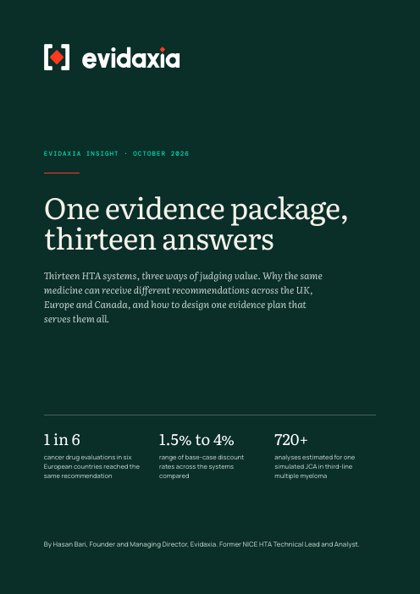
One evidence package, thirteen answers.
Our 21-page guide compares thirteen HTA systems across the UK, Europe and Canada, with 16 exhibits and full references. Subscribe to Evidaxia Briefing, our sourced analysis of market access, HTA decisions, evidence and health policy, and the guide downloads the moment you subscribe.
What is PICO scoping in the EU joint clinical assessment?
It is the process by which the assessor, co-assessor and Member States define the populations, intervention, comparators and outcomes that the JCA will assess. Article 8(6) of Regulation (EU) 2021/2282 requires the scope to be inclusive and to reflect Member States' needs.
How long does a company have to submit the JCA dossier after scoping?
Under Implementing Regulation (EU) 2024/1381, the dossier is due within 100 days of notification of the Commission's first request, which carries the finalised scope. The period is 60 days for accelerated assessments and certain variations.
Can the health technology developer influence the JCA scope?
The developer provides information at filing and may be invited to supply further scoping information, but it does not draft the scope. After finalisation it can request an explanation meeting, held within 20 days.
Why do JCA scopes contain many PICOs?
Member States use different comparators and define subpopulations differently. The HTACG consolidation rules merge requests where possible, but a PICO is retained when a Member State requires it and says it cannot be dropped, and individualised treatment comparators always form a separate PICO.
How many PICOs were in the first published JCA reports?
The tovorafenib report had 8 PICOs across three populations, the tarlatamab report 7 across four populations, and the lurbinectedin report 1, according to the Commission's summary reports.
How should SLRs be designed for a JCA?
Reviews should be broad enough to capture every plausible EU comparator, include a covariate review for adjusted comparisons, and be refreshed so that the search cut-off is no more than three months before dossier submission, as the HTACG Q&A requires.
Preparing for a JCA scope? Start with the evidence matrix.
Start with a free, no-obligation 30-minute call with a senior consultant.