
One Regulation. 27 Speeds.
The Evidaxia JCA Readiness Index: which EU member states are ready for joint clinical assessment, which are not, and what that means for every launch planned for 2027.
JCA reports published
First on 9 June 2026; the fourth, and first ATMP, on 7
September
JCAs initiated by June 2026
HTACG plans roughly 58 for 2026 across oncology, ATMPs and
devices
member states we rate Frontrunner
Together home to roughly half of the EU population
PICOs answered with comparative evidence
in the very first JCA report (tovorafenib)
Executive summaryThe bottom line
Eighteen months after the EU HTA Regulation began to apply, the joint clinical assessment works. Four reports are public, the first ATMP has been through, and the Coordination Group is planning for roughly 58 JCAs in 2026. The Brussels half of the reform has arrived. The national half has not, and that is where the next two years of access speed will be decided.
The JCA machine is producing reports: Tovorafenib (June), lurbinectedin and tarlatamab (July) and Itvisma (September) are now public in all 24 official languages.
National readiness is uneven: Our index scores all 27 member states on five dimensions. The EU mean is 54 out of 100. Six countries score 75 or more, and seven score below 35.
Half of Europe's patients sit in the ready half: Germany, France, the Netherlands, Denmark, Sweden and Spain are home to roughly half of the EU population. The other half live in 21 systems that are still writing, or have not started writing, the rules for using a JCA.
Evidence design decides the result, not dossier writing: The first report found comparative evidence for 1 of 8 PICOs. Tarlatamab, a month later, covered 7 of 7. Same process, different evidence architecture.
One agency is writing a large share of Europe's assessments: Germany's IQWiG lists nine JCAs on its website. German methodological standards are becoming the EU default, whether other countries planned for it or not.
A JCA is not a launch. It is the starting gun for 27 separate races, and the runners are not standing at the same line.
Section 1The regulation is uniform. The readiness is not.
Regulation (EU) 2021/2282 has applied since 12 January 2025 to new oncology active substances and advanced therapy medicinal products. It gives every member state the same clinical assessment, with the same PICOs and the same evidence tables, published in every official language. On paper, a manufacturer submits once and 27 health systems read the same document.
In practice, the JCA covers only the relative clinical effectiveness and safety question. Pricing, cost-effectiveness, budget impact and the reimbursement decision stay national, and each country decides for itself how much weight the JCA carries, when its own clock starts, and what else it asks for. The regulation obliges member states to give the report "due consideration". It does not tell them how.
So the practical question for any company with a 2027 or 2028 launch is not whether the JCA will happen. It is what happens in the 12 months after the report is published, country by country. That is what this article sets out to measure.
Exhibit 1From regulation to routine: the JCA timeline so far
Four reports in four months after a slow first year. The pace is now set by pipeline, not procedure.
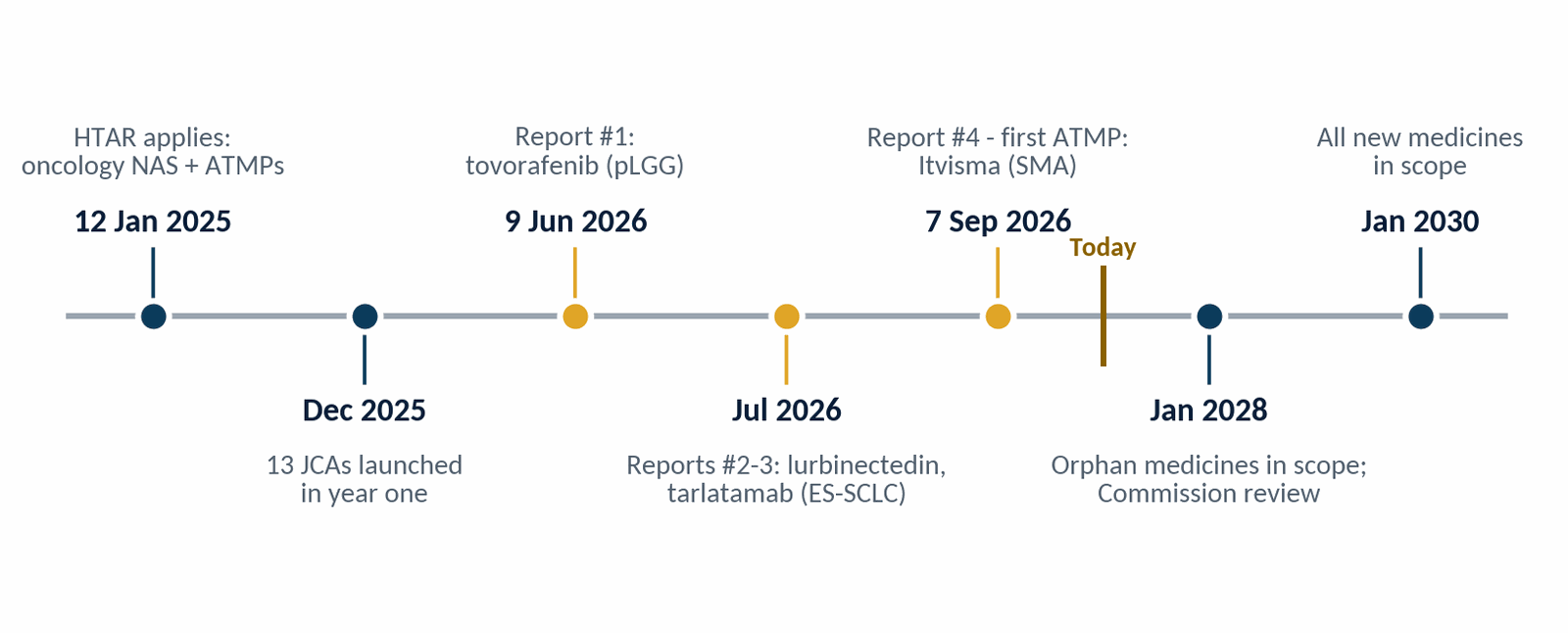
Source: European Commission (JCA report publications, 9 June and 7 September 2026); Becaris Publishing (reports 2 and 3, July 2026); HTACG 2025 Annual Report (13 JCAs launched in 2025); Regulation (EU) 2021/2282. Milestones are spaced for legibility, not to scale.
The volume is about to rise sharply
The HTACG reported 13 JCAs launched in 2025. By the time the first report was published on 9 June 2026, the Commission counted 18 initiated. Its 2026 work programme plans for roughly 35 oncology JCAs, 15 ATMPs, 5 medical devices and 3 variations this year, as reported by pharmaphorum. The quiet first year was partly a choice by manufacturers. Analysts at Remap Consulting attribute the low 2025 numbers in part to sponsors deferring filings to avoid the first wave, and pharmaphorum reports that 57% of 2025 letters of intent arrived late.
That deferral window has closed. Orphan medicines come into scope in January 2028, the same year the Commission formally reviews the regulation. Every national system that is not ready by then will be tested at volume.
Section 2What the first four reports tell us
Tovorafenib (Ojemda, paediatric low-grade glioma): Ireland's NCPE and Germany's IQWiG assessed it. The HTACG endorsed the report on 30 April 2026 and the Commission published it on 9 June. Member states asked eight PICOs across three populations. The dossier offered comparative evidence for one of them, covering roughly 17% of the indicated population according to Lumanity's analysis, and that comparison rested on an unanchored MAIC with an effective sample size of 5.81. The assessors called the manufacturer's approach to searching for comparators "not adequate".
Lurbinectedin and tarlatamab (extensive-stage small cell lung cancer): IQWiG led both, with Portugal's INFARMED and Hungary's NNGYK as partners. Lurbinectedin faced a single PICO, tarlatamab seven. Both dossiers answered every PICO with comparative evidence, using direct comparisons where they existed and network meta-analyses, anchored indirect comparisons and MAICs where they did not.
Itvisma (intrathecal onasemnogene abeparvovec, spinal muscular atrophy): Ireland and France assessed the first ATMP to complete the process, against nusinersen, risdiplam and best supportive care. The report, published on 7 September 2026, notes that some of the comparisons still rest on limited data. Industry press has already framed it as a report that highlights the evidence problem for one-off gene therapies.
Exhibit 2PICO count is not destiny. Evidence architecture is.
Tarlatamab faced almost as many PICOs as tovorafenib and still answered all of them.
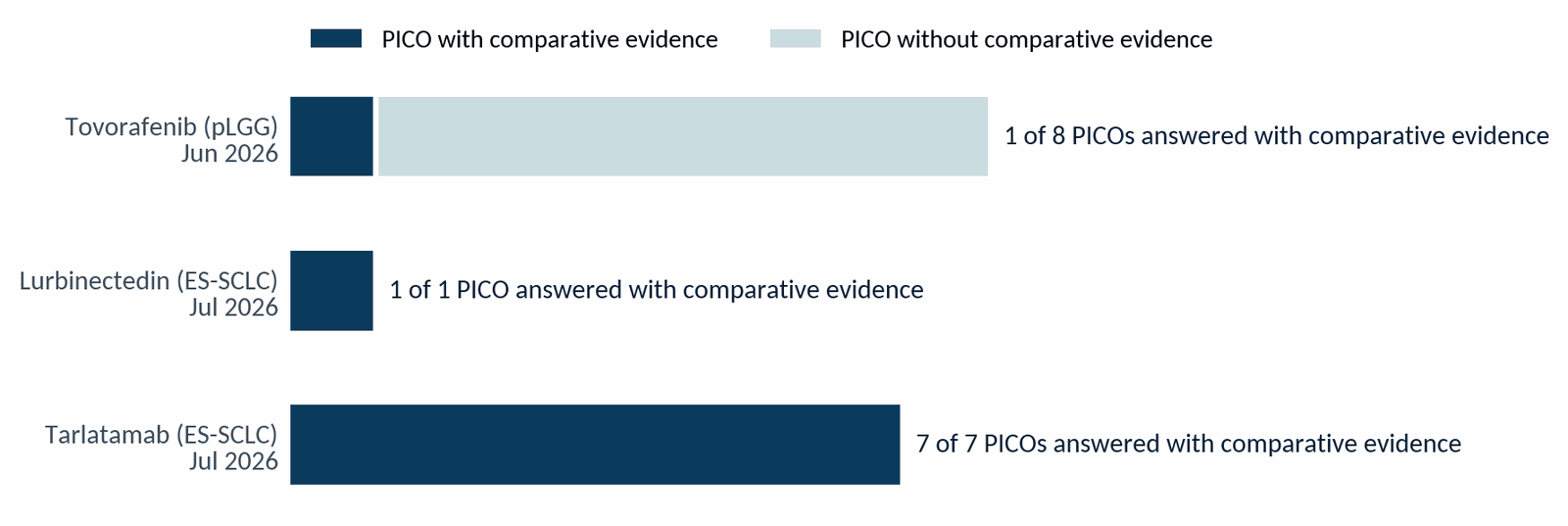
Source: Lumanity, Beyond the Headlines (June 2026); Becaris Publishing (July 2026). The Itvisma report is excluded because its PICO-level breakdown had not been analysed publicly at the cut-off date.
The lesson is less comfortable than it looks. Seven PICOs is not the problem. A single-arm pivotal trial with no plan for how it will be compared against each national standard of care is the problem. The JCA methods guidance says openly that non-randomised evidence carries much greater potential for bias, and the assessors have applied it.
Section 3The Evidaxia JCA Readiness Index
We scored each of the 27 member states on five dimensions, 0 to 4 each, from public evidence available on 24 September 2026. The five scores sum to 20, which we rescale to an index from 0 to 100.
Legal and procedural integration: Has the country changed its law, decree or HTA rules so that a JCA formally enters the national process?
Timeline sequencing: Has it said when national work starts relative to JCA publication, and whether it will wait, pause or run in parallel?
EU engagement: Has its HTA body taken a publicly confirmed assessor or co-assessor role on a JCA?
HTA capacity and methods: How established is the national HTA body, and has it aligned its methods guidance with the JCA framework?
Early dialogue and PICO input: Does it offer early advice or a formal route for manufacturers to comment on PICOs? We drew this from the 25-country survey by D'Oca and colleagues (2026).
Tiers: Frontrunner 75 to 100, Adapter 55 to 74, Emerging 35 to 54, Lagging below 35.
Exhibit 3Europe's JCA readiness, country by country
A north-west core, a fast-moving Iberia, and a central and south-eastern belt still waiting for rules.
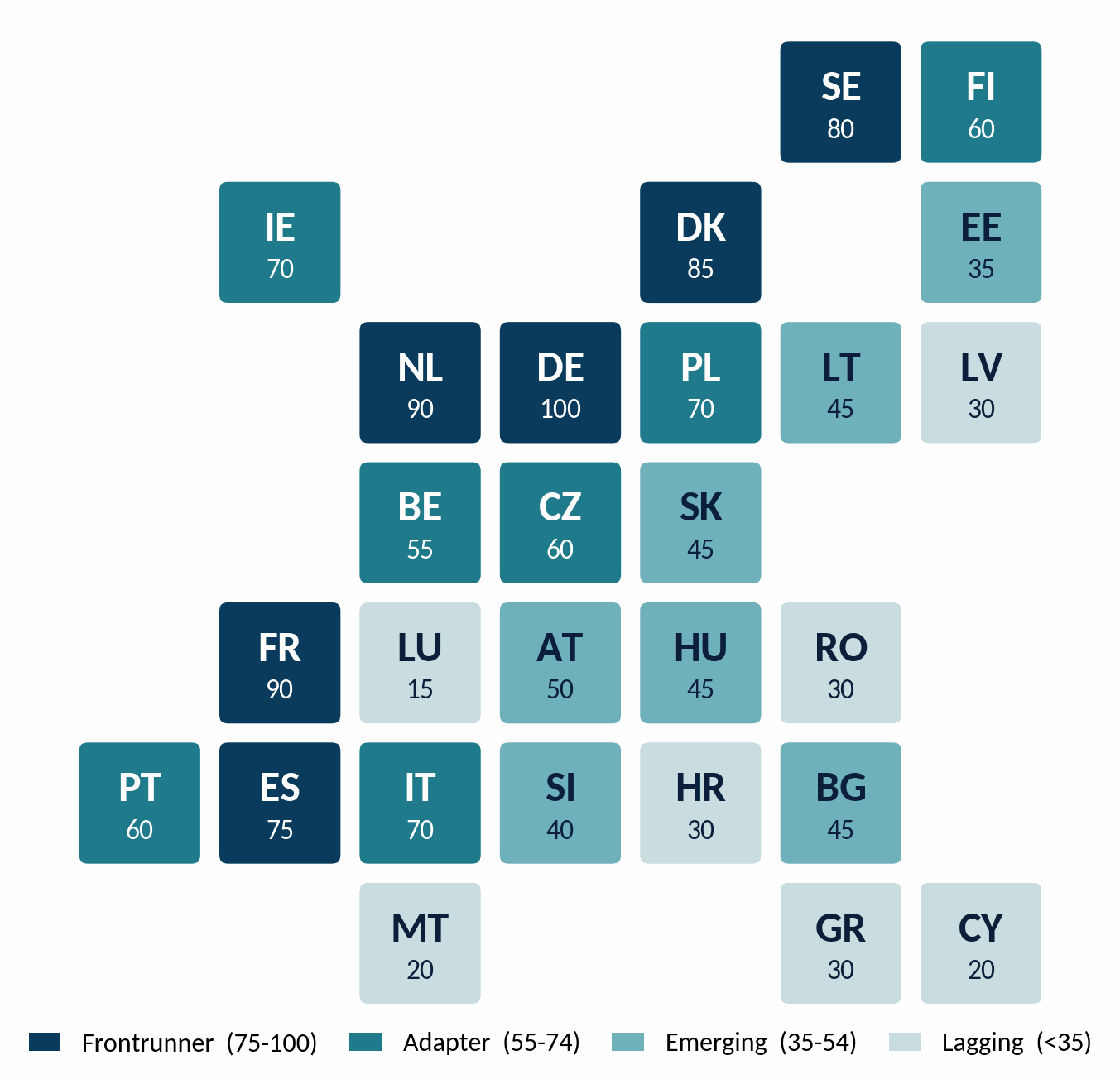
Source: Evidaxia analysis of national HTA agency publications, legislation and peer-reviewed and industry trackers (full list at the end). Scores are Evidaxia judgements from public evidence at 24 September 2026. Tile positions approximate geography.
Exhibit 4The index ranks Germany first and Luxembourg last
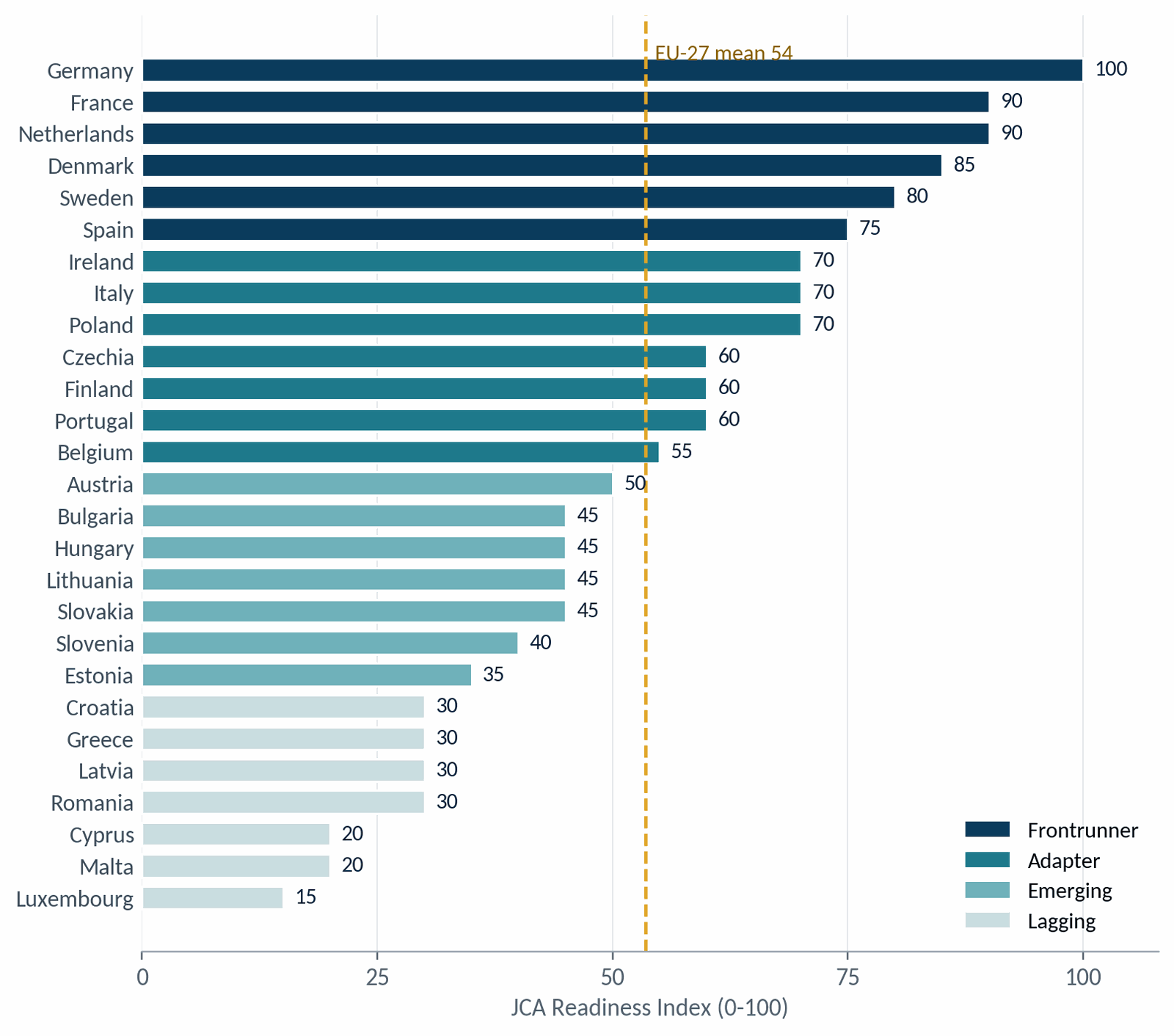
Source: Evidaxia JCA Readiness Index, September 2026. Dashed line marks the EU-27 unweighted mean of 54.
Three findings that surprised us
Spain moved fastest: Royal Decree 415/2026 of 27 May 2026 gave Spain its first state-level HTA framework and commits the national clinical evaluation to within 20 days of JCA publication. A country that most trackers rated "early stage" in 2025 now has a clock that is shorter than most of its neighbours'.
Small agencies are sitting at the big table: Hungary, Slovakia and Slovenia have each partnered IQWiG on a JCA, yet none of them has published national rules on how it will use a JCA. Their assessors will know the reports better than their own reimbursement committees do.
Italy re-wired its institutions before its dossier: AIFA's revised HTA guidelines took effect on 1 April 2026, a single Scientific and Economic Committee (CSE) replaced the old CTS and CPR, and AIFA announced a dedicated Office for European HTA Procedures. The national price and reimbursement dossier was still being aligned in late 2025, which is why Italy scores as an Adapter rather than a Frontrunner.
Section 4Four archetypes, four launch strategies
A single score hides the thing a launch team most needs to know, which is why a country is ready or not. We separated national integration (law and timelines) from EU engagement and capability (assessor roles, HTA capacity and early dialogue). The two do not move together.
Exhibit 5National integration and EU engagement are different kinds of readiness
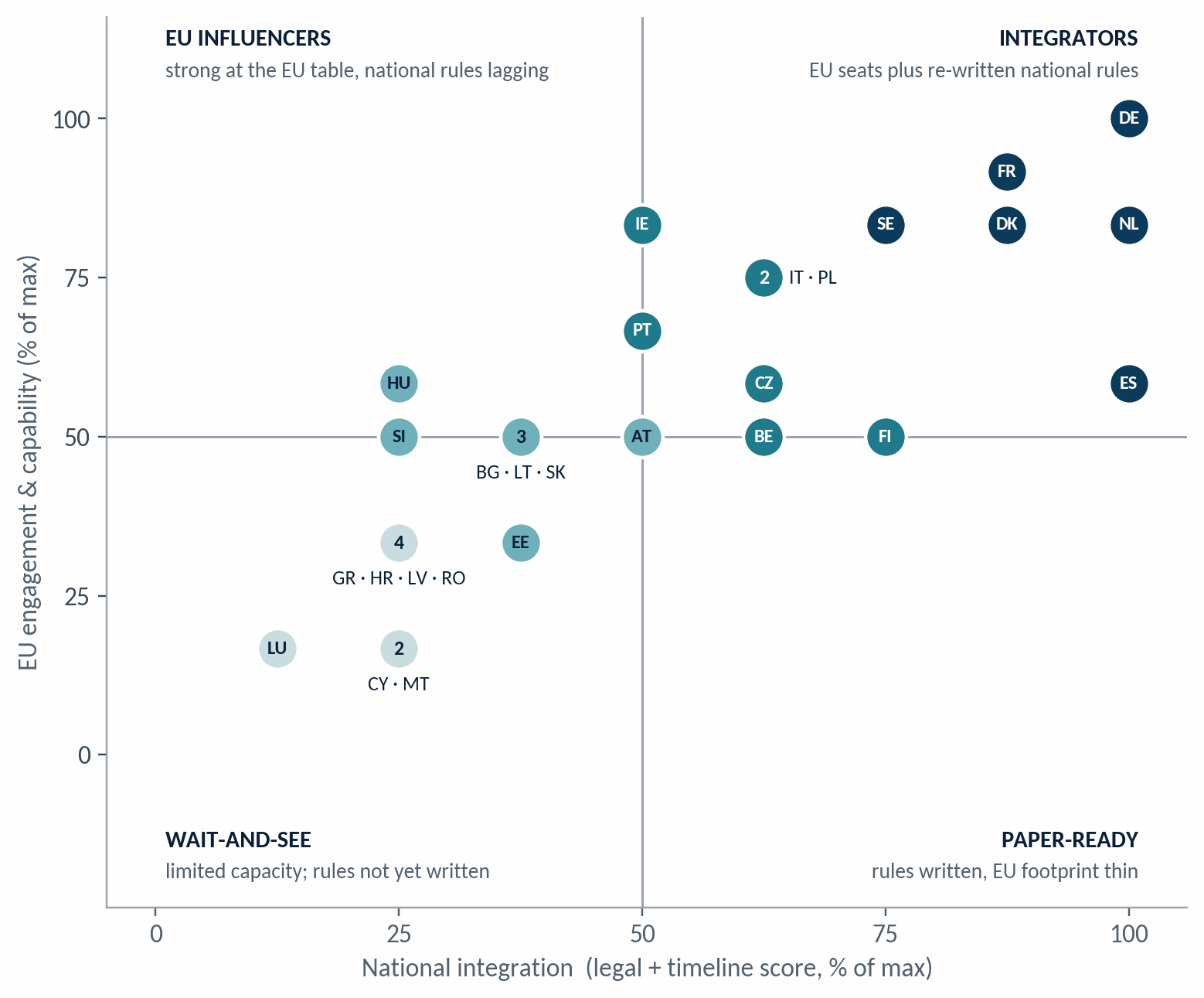
Source: Evidaxia JCA Readiness Index, September 2026. x-axis combines the legal and timeline scores; y-axis combines EU engagement, HTA capacity and early-dialogue scores. Numbered dots show several countries with identical scores.
Integrators
Germany, France, the Netherlands, Denmark, Sweden; Italy, Poland, Czechia and Spain close behind
These systems have written the JCA into national procedure and hold assessor seats. Germany's G-BA lets companies reference the EU dossier, requires IQWiG to take the JCA into account, and can pause its own assessment for up to three months to wait for the report. The Netherlands built a JCA-specific dossier template and starts its full assessment only after publication. France chose the opposite trade-off and does not delay its national clock for the JCA.
So what: Treat the JCA as the core of the national submission. The work shifts to the delta dossier and to economic value.
EU Influencers
Ireland, Hungary; Portugal, Slovakia and Slovenia on the boundary
Their agencies are assessing JCAs, and Ireland led the first one while holding the EU Council Presidency from July 2026. National rules for using the report are thinner or unpublished.
So what: Expect well-informed reviewers. The national team will know the JCA's weaknesses in detail, so answer them before you are asked.
Paper-ready
Belgium, Finland
The rules exist. Belgium folded the JCA into the third edition of its economic guidelines in June 2025, and Finland starts its assessment after the JCA. Neither has yet held an assessor seat that we could confirm.
So what: Low procedural risk, but check that local comparators and cost-effectiveness requirements are met on day one.
Wait-and-see
Austria, Bulgaria, Lithuania, Estonia, Greece, Romania, Croatia, Latvia, Cyprus, Malta, Luxembourg
These countries have announced intentions, are drafting guidance, or have said nothing in public. Several have no formalised HTA process for medicines at all.
So what: Plan for a full national dossier regardless of the JCA. This is where access delays compound, and where early payer dialogue returns the most.
Section 5Who is actually writing Europe's assessments
Every JCA pairs an assessor with a co-assessor. IQWiG's website lists nine JCAs it is working on, with start dates from March 2025 to July 2026 and partners from nine other countries. Set against the 18 JCAs the Commission counted in June, that is roughly half of the work so far.
Exhibit 6Publicly confirmed assessor and co-assessor roles, by member state
Germany's weight in the process is not a rumour. It is on IQWiG's own website.
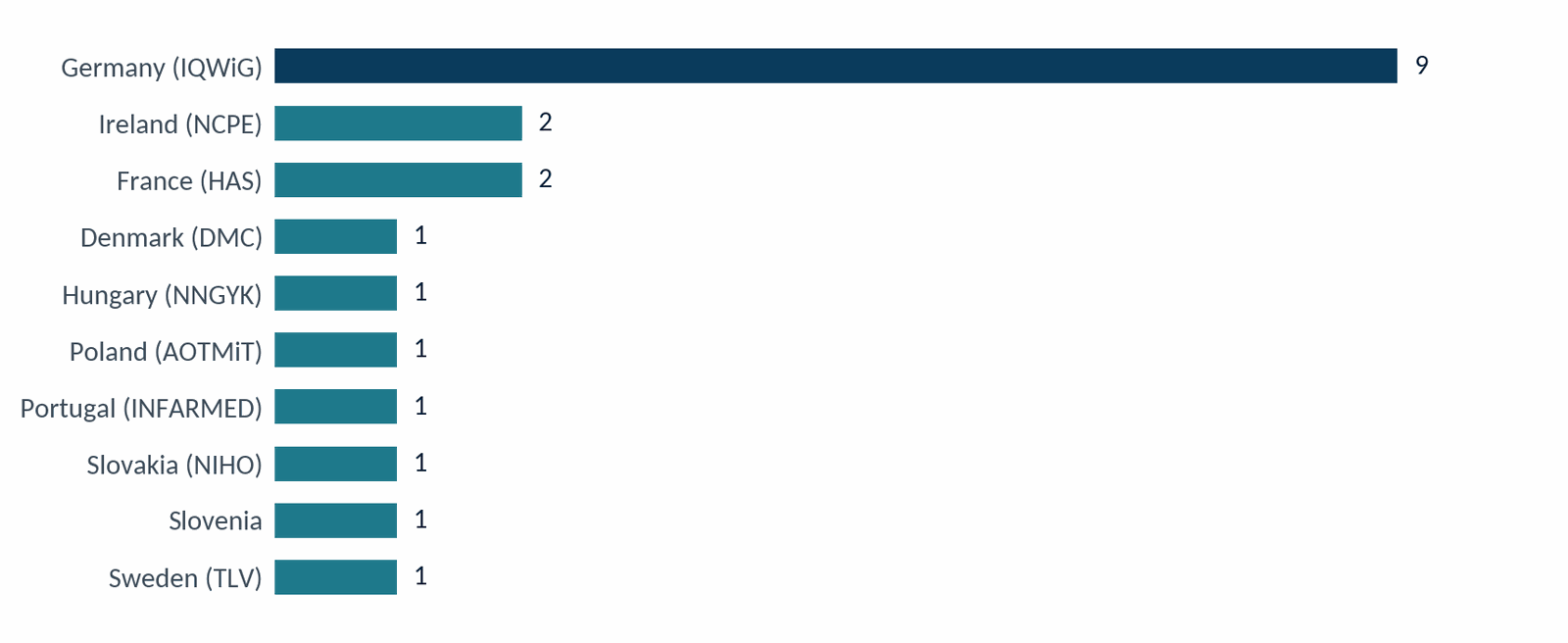
Source: IQWiG, European health technology assessment (JCA table, accessed September 2026); NCPE (May 2026); Agence Europe (September 2026, Itvisma). Counts include only roles we could confirm in public sources and understate agencies working on ATMP JCAs that are not yet published.
This matters for evidence planning. IQWiG's methods are strict on indirect comparisons, and pharmaphorum reports that the G-BA has rejected 71.5% of indirect treatment comparisons on methodological grounds. If the agency that shapes half of the reports holds that line, manufacturers who design their evidence for a median European payer will be designing for a different reader than intended.
We also think the concentration is a risk for the system itself. The regulation assumes that assessment capacity spreads across member states over time. At the current rate, the 2028 orphan wave will land on the same handful of agencies that carry the load today.
Section 6The full scorecard
Exhibit 7Readiness by dimension, all 27 member states
The least developed column across the EU is EU engagement. The strongest is HTA capacity, which means most systems have the people but not yet the rules.
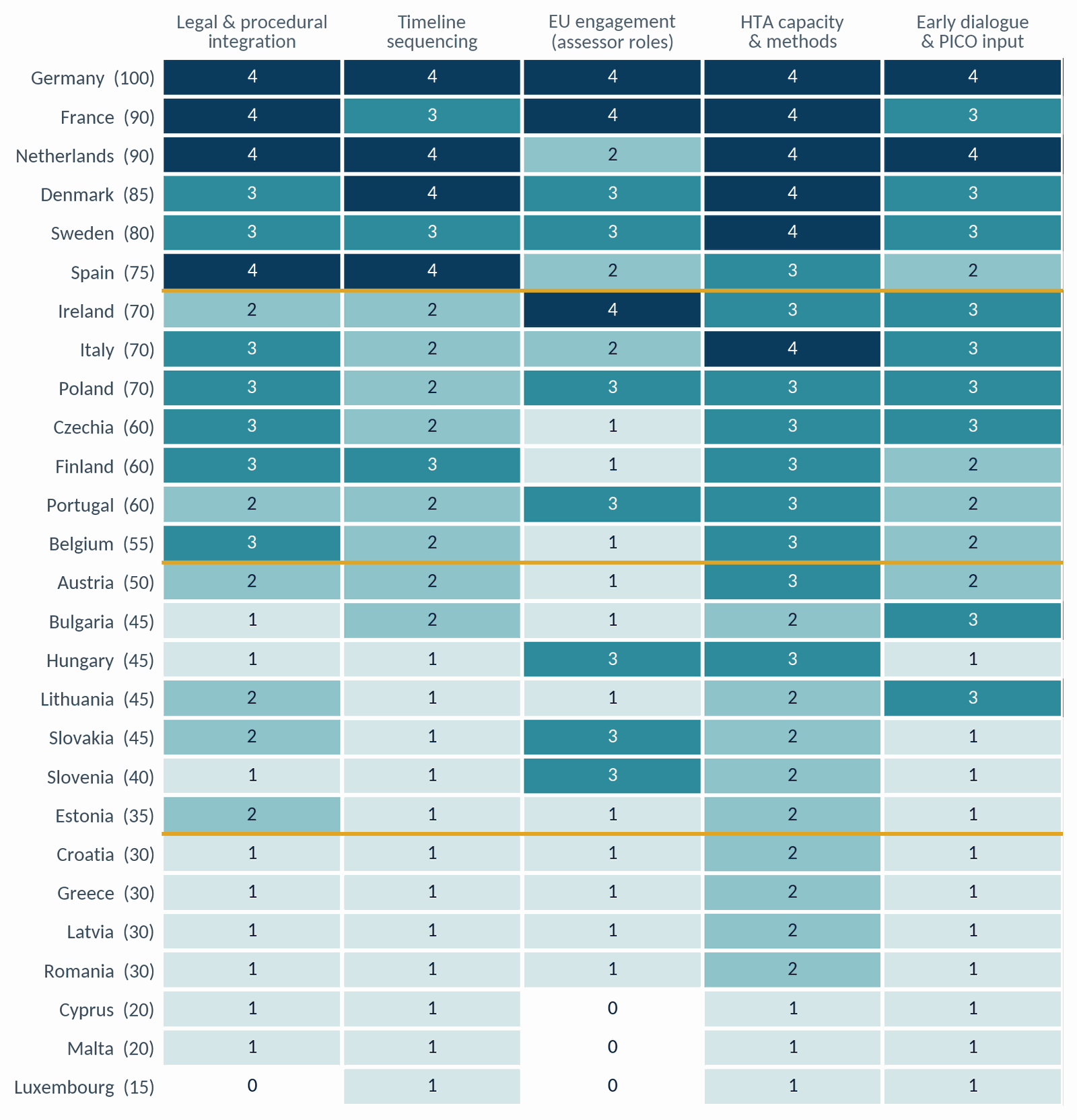
Source: Evidaxia JCA Readiness Index, September 2026. Scores run from 0 (no public evidence) to 4 (fully in place). Amber lines separate the four tiers.
Section 7Five moves for 2027 launch teams
Model the PICOs 18 months before filing: Build scenarios for the strictest plausible comparator set, usually the German and French standard of care, and test your trial against them before the design is locked. The first JCA shows what happens when the PICOs are discovered at the scoping stage.
Plan indirect comparisons to JCA standards, not national habits: An unanchored MAIC with an effective sample size in single digits will be described, not used. Anchored comparisons, network meta-analyses, and external control arms designed prospectively are the currency.
Sequence the European roll-out by archetype, not only by market size: In Integrators, the JCA will shorten the national work. In Wait-and-see countries, assume a full national dossier and budget for local evidence.
Write the delta dossier now: For each priority market, list what the national body needs beyond the JCA: local comparators, cost-effectiveness, budget impact, and any national outcome it prefers. Spain's 20-day clinical evaluation window leaves no time to start after publication.
Use the new patient and clinician routes: The Commission published three templates on 14 September 2026 for written input from patients, carers and clinicians. The Itvisma report shows how much the interpretation of limited data can depend on clinical context.
The next 90 days
| When | Action | Who owns it |
|---|---|---|
| By end of October | Map every asset due for EMA filing before mid-2028 against JCA scope, including orphan designations entering in January 2028. | Market access lead |
| By end of November | Run a PICO simulation for each asset using current standards of care in at least six member states, one from each archetype. | HEOR and medical |
| By end of December | Draft a country roll-out plan that assigns each target market to an archetype and names the national evidence gaps. | Market access and pricing |
| Ongoing | Track national rule changes quarterly. Spain, Italy, Poland and Czechia all changed their rules between early 2025 and mid-2026. | Policy or public affairs |
The Commission will judge the JCA in 2028 by how fast patients get access. That will be decided in national capitals, not in Brussels.
Appendix aCountry snapshots
| Member state | Index | Tier | What the public evidence shows |
|---|---|---|---|
| Germany | 100 | Frontrunner | AM-NutzenV amended (Mar 2025); G-BA rules (Jul 2025) let firms reference EU dossier, pause up to 3 months for JCA; IQWiG on 9 JCAs. |
| France | 90 | Frontrunner | HAS integration; dossier template updated, written early advice (Oct 2025); national clock not delayed; assessor on Itvisma, partner on cosibelimab. |
| Netherlands | 90 | Frontrunner | ZIN new procedure & JCA-specific dossier template (Feb 2025), 'core document', dedicated JCA assessors; national review starts post-JCA. |
| Denmark | 85 | Frontrunner | National coordination group; national assessment starts post-JCA; Danish Medicines Council partner on daraxonrasib; PICO feedback. |
| Sweden | 80 | Frontrunner | TLV procedural alignment (Mar 2025) with Joint Nordic HTA-Bodies; partner on taletrectinib; phase III advice. |
| Spain | 75 | Frontrunner | Royal Decree 415/2026 (27 May 2026): first state HTA framework; clinical evaluation 20 days after JCA publication. |
| Ireland | 70 | Adapter | NCPE assessor on the first JCA (tovorafenib) and Itvisma; PICO feedback; Council Presidency H2 2026. |
| Italy | 70 | Adapter | AIFA HTA guidelines effective 1 Apr 2026; new CSE committee; Office for European HTA Procedures; P&R dossier alignment ongoing. |
| Poland | 70 | Adapter | Reimbursement Act amended (Jul 2025); AOTMiT partner on mezigdomide; guideline update pending. |
| Czechia | 60 | Adapter | Legislative changes enacted (2025); guidelines not yet published; capacity constraints; PICO feedback. |
| Finland | 60 | Adapter | National assessment starts post-JCA; HTD input on PICO allowed. |
| Portugal | 60 | Adapter | INFARMED co-assessor on lurbinectedin; guideline/method update in progress. |
| Belgium | 55 | Adapter | JCA integrated in 3rd edition economic guidelines (Jun 2025); national cost-effectiveness criteria retained. |
| Austria | 50 | Emerging | Updating HTA guidelines/methods to align with EU requirements. |
| Bulgaria | 45 | Emerging | Planning shorter timelines; limited disclosure; PICO feedback mechanism. |
| Hungary | 45 | Emerging | NNGYK co-assessor on tarlatamab; no national JCA guidance publicly issued. |
| Lithuania | 45 | Emerging | Announced intention to incorporate JCAs; drafting guidelines; PICO feedback mechanism. |
| Slovakia | 45 | Emerging | NIHO partner on sintilimab; self-assessed 'ready' in EC panels. |
| Slovenia | 40 | Emerging | Slovenian agency partner on senaparib; national integration rules not yet public. |
| Estonia | 35 | Emerging | Announced intention to incorporate JCAs; drafting new guidelines. |
| Croatia | 30 | Lagging | Established HTA process; no public JCA integration rules. |
| Greece | 30 | Lagging | Intention announced; no national JCA guidance issued. |
| Latvia | 30 | Lagging | Established HTA process; no public JCA integration rules. |
| Romania | 30 | Lagging | No national JCA guidance issued; HTA/pricing methodology reform (World Bank-supported) still pending. |
| Cyprus | 20 | Lagging | No formalised local HTA process (self-assessed not ready). |
| Malta | 20 | Lagging | Small system; relies on reference/partner assessments. |
| Luxembourg | 15 | Lagging | No formalised local HTA process (self-assessed not ready). |
Appendix bMethod, limits and how to challenge us
We built the index from public sources only: national legislation and agency websites, Commission publications, peer-reviewed studies and industry trackers published between January 2025 and 24 September 2026. Evidaxia analyst judgement sits behind every score, and we have kept the scoring rules deliberately simple so that readers can disagree with a specific cell rather than with the whole index.
The index has limits that a reader should weigh. Absence of public evidence scores low, so a country that has changed its internal practice without publishing it will be understated. The EU engagement dimension is the least developed, because the Commission's JCA list is not easy to read at scale and we counted only roles that we could confirm in public. Non-EU EEA countries (Norway, Iceland, Liechtenstein) apply the regulation too, but fall outside this index. On our criteria, Norway would likely score as an Integrator.
If you work in a national HTA body or a local affiliate and think we think a score needs revising, tell us. We will update the index quarterly and credit corrections.
Sources
1. European Commission. Commission publishes first Joint Clinical Assessment on innovative medicine (9 June 2026). health.ec.europa.eu
2. European Commission. Joint Clinical Assessment report on tovorafenib (Ojemda). health.ec.europa.eu
3. European Commission. Joint Clinical Assessments (latest updates, including Itvisma report 7 Sep 2026 and input templates 14 Sep 2026). health.ec.europa.eu
4. European Commission, SANTE newsletter. HTA Coordination Group publishes its 2025 Annual Report. ec.europa.eu
5. Agence Europe. Commission publishes joint clinical assessment of Itvisma (September 2026). agenceurope.eu
6. Becaris Publishing. Second and third Joint Clinical Assessments published (July 2026). becarispublishing.com
7. Lumanity. Beyond the headlines: assessing the first JCA report on tovorafenib (June 2026). lumanity.com
8. NCPE Ireland. First joint clinical assessment of benefit complete (May 2026). ncpe.ie
9. IQWiG. European health technology assessment (JCA table). iqwig.de
10. G-BA. Neue Arzneimittel: G-BA definiert Verfahrensregeln bei vorangegangener EU-Bewertung (17 July 2025). g-ba.de
11. BOE. Real Decreto 415/2026, de 27 de mayo, por el que se regula la evaluación de tecnologías sanitarias. boe.es
12. Diariofarma. JCA y nuevos dominios ponen a prueba la evaluación de tecnologías sanitarias española (22 Sep 2026). diariofarma.com
13. Remap Consulting. Italy HTA AIFA 2026: pricing and reimbursement implications. remapconsulting.com
14. D'Oca K, Adriano A, Darquennes E, Steck N. From Joint Clinical Assessment to national decisions. J Mark Access Health Policy 2026;14(3):50. doi.org
15. ISPOR. Bridging national and EU HTA regulation: policy responses to the JCA rollout. ispor.org
16. ISPOR Europe 2025. National implementation of the EU HTA Regulation: progress across member states. ispor.org
17. OHE. One Europe, one assessment? Unpacking the European Joint Clinical Assessment. ohe.org
18. Parexel. EU member states' readiness for JCA implementation (January 2025). parexel.com
19. Remap Consulting. How are countries implementing the EU HTA Regulation? (2025). remapconsulting.com
20. Remap Consulting. If you are a market access lead in 2026. remapconsulting.com
21. pharmaphorum. Europe's new HTA reality: the JCA, one year on (August 2026). pharmaphorum.com
22. Clinical Trials Arena. EU's Joint Clinical Assessment system still finding its footing. clinicaltrialsarena.com
23. Executive Insight. Integration of JCA within existing HTA bodies (December 2025). executiveinsight.ch
Where does your next launch sit on this map?
Evidaxia is an HEOR, HTA and market access consultancy working with pharma, MedTech and HealthTech companies. We model PICO scenarios before trial designs are locked, build indirect comparisons to JCA standards, and write the national delta dossiers that turn a JCA into reimbursement.
Bari, Founder and Managing Director of Evidaxia, brings more than a decade of healthcare experience, including work as an HTA Technical Lead and Analyst at NICE contributing to published technology appraisal guidance in oncology, rare diseases and diagnostics, and now advises manufacturers on EU and national HTA submissions.
Email info@evidaxia.com for a country-by-country readiness read-out on your asset.
This article reflects public information available on 24 September 2026 and Evidaxia's independent analysis. It is not legal advice. Readiness scores are analytical judgements and do not represent the views of any national authority or of the European Commission.
One evidence package, thirteen answers.
Our 21-page guide compares thirteen HTA systems across the UK, Europe and Canada, with 16 exhibits and full references. Subscribe to Evidaxia Briefing, our sourced analysis of market access, HTA decisions, evidence and health policy, and the guide downloads the moment you subscribe.