
US most-favored-nation drug pricing: what GLOBE, GUARD and GENEROUS mean for UK and European launches
US most-favored-nation pricing has moved from an executive order to three CMS payment models and a set of manufacturer agreements. Prices set in London, Dublin and other European capitals now carry consequences in the US, and launch planning has to reflect that.
From executive order to payment models
On 12 May 2025 the President signed Executive Order 14297, "Delivering Most-Favored-Nation Prescription Drug Pricing to American Patients". It directed the Secretary of Health and Human Services to communicate most-favored-nation (MFN) price targets to manufacturers within 30 days, "to bring prices for American patients in line with comparably developed nations", and to propose rulemaking if significant progress was not made.[1]
On 20 May 2025 HHS defined the target: the lowest price in an OECD country with a GDP per capita of at least 60% of the US level. HHS said it expected manufacturers to align US pricing for brand products without generic or biosimilar competition with that benchmark.[2]
The policy now runs on two tracks. One is voluntary: manufacturer agreements and a Medicaid model, GENEROUS. The other is mandatory: two Medicare models, GLOBE for Part B and GUARD for Part D. Each reads international prices differently, and that detail is what matters for European pricing and HTA teams.
Manufacturer agreements: what is public
The first agreement was announced on 30 September 2025. According to the White House fact sheet, the company agreed to give every state Medicaid programme access to MFN prices and to guarantee MFN prices on all new innovative medicines it brings to market, alongside direct-to-patient discounts.[3] On 19 December 2025 the White House announced nine further agreements, bringing the total to 14 since 30 September. The stated commitments again included Medicaid MFN pricing and MFN prices for new launches, together with sales through the TrumpRx direct-to-patient channel and a commitment to repatriate increased foreign revenue on existing products that results from US trade policy.[4]
The detailed terms are not public. KFF has noted that the specific terms of these agreements remain confidential.[5] A law-firm review of the GLOBE final rule describes the largest manufacturers, and then a group of mid-size companies, entering arrangements between late 2025 and August 2026.[6] We would therefore treat any statement about how a particular agreement defines the "MFN price" for a new launch as company-specific and unverifiable from the outside.
GENEROUS: MFN pricing in Medicaid
CMS announced the GENErating cost Reductions fOr U.S. Medicaid (GENEROUS) Model on 6 November 2025.[7] It is voluntary for manufacturers and for states, launched in January 2026 and is planned to run for five years through 2030.[5, 7]
- Reference basket: Eight countries: the United Kingdom, France, Germany, Italy, Canada, Japan, Denmark and Switzerland.[5]
- Benchmark: The second-lowest country-specific, manufacturer-reported net price, after rebates and discounts, averaged over the previous 12 months and adjusted by GDP per capita using a purchasing power parity (PPP) method.[7]
- Mechanism: A supplemental rebate equal to the wholesale acquisition cost minus the sum of a guaranteed net unit price, set from the MFN price, and the standard Medicaid unit rebate amount.[7]
Two features stand out for European teams. GENEROUS uses manufacturer-reported net prices, so confidential discounts are in scope by design. And the UK is one of only eight reference countries, which gives UK net prices more weight here than in the Medicare models.
GLOBE: the Medicare Part B model
The Global Benchmark for Efficient Drug Pricing (GLOBE) Model final rule was published in the Federal Register on 2 October 2026 (91 FR 62936) and takes effect on 30 November 2026.[8] The model begins on 1 January 2027 with a period of voluntary manufacturer data submission. Performance years run from 1 April 2027 to 31 March 2032, and rebate invoicing and reconciliation continue to 31 March 2034.[8, 9] The proposed start of 1 October 2026 was replaced.[9]
Scope
- Mandatory for manufacturers of in-scope drugs, applied to Original Medicare Part B utilisation by beneficiaries in randomly selected geographic areas covering about 25% of eligible beneficiaries.[8, 9]
- Drugs: Part B rebatable single source drugs and sole source biologicals in seven USP categories (antigout agents, antineoplastics, blood products and modifiers, central nervous system agents, immunological agents, metabolic bone disease agents and ophthalmic agents) with more than $100 million of Part B spending over a 12-month look-back, a threshold the final rule adjusts for inflation.[8, 10]
- Exclusions: orphan-only drugs (designated for one or more rare diseases with only rare-disease indications), FDA-listed cell and gene therapies, plasma-derived products, drugs with a negotiated maximum fair price, drugs no longer Part B rebatable, drugs in quarters before a specified amount has been identified, and biosimilars and their reference products once a biosimilar enters the US market. The orphan, cell and gene therapy and plasma exclusions were added after consultation.[8, 9, 10]
Reference basket
CMS identified reference countries once, as non-US OECD members at 1 October 2025 with real GDP per capita of at least 60% of the US level and annual real GDP of at least $400 billion, on a PPP basis using 2024 data. The 19 countries are Australia, Austria, Belgium, Canada, the Czech Republic, Denmark, France, Germany, Ireland, Israel, Italy, Japan, the Netherlands, Norway, South Korea, Spain, Sweden, Switzerland and the United Kingdom. On the data CMS used, their 2024 real GDP per capita ranged from 63% to 170% of the US level, and the list stays fixed for the performance period.[8]
Effect of the final rule
CMS now estimates overall Part B net savings of $440 million over the seven-year payment period, about $80 million a year when annualised, compared with about $2.3 billion a year in the proposed rule.[8, 9] The difference reflects the new exclusions and CMS's stated intention to waive GLOBE participation, under its section 1115A authority, for manufacturers participating in GENEROUS in the same quarter. Assuming manufacturers that had signed GENEROUS agreements by 17 August 2026 receive that waiver, CMS estimates that the number of manufacturers of GLOBE drugs falls from 19 to 4.[8, 10] The waiver is a stated intention rather than a codified provision.[9]
How the GLOBE benchmark is calculated
For each drug and quarter, CMS calculates two benchmarks and uses the greater of them:[8, 9]
- Method I uses existing international pricing data sources identified by CMS. Each country-level price per HCPCS billing unit is multiplied by that country's GDP (PPP) adjuster, and the lowest adjusted price becomes the benchmark. It is then multiplied by an applicable threshold percentage of 102%.
- Method II uses voluntary manufacturer submissions of international net prices. It is the volume-weighted average of GDP (PPP)-adjusted net prices across reference countries, multiplied by 105%. Submissions are due within 30 days of the end of the applicable ASP quarter, and manufacturers must sign a data agreement first.[10]
The GDP (PPP) adjuster is US real GDP (PPP) per capita divided by the country's real GDP (PPP) per capita, rounded to three decimal places. Where the ratio is below 1.000 it is set to 1.000. After the CIA World Factbook ceased publication on 4 February 2026, CMS moved the data source to the World Bank World Development Indicators series (NY.GDP.PCAP.PP.CD), with the IMF as fallback, and will publish the adjusters each quarter.[8] The benchmark amount adds the dollar value of the Part B add-on percentage. The per-unit GLOBE rebate is based on the specified amount minus the benchmark amount, and the manufacturer pays the increment over any existing Part B inflation rebate.[8, 10]
CMS explains the 2% margin directly: Method I data sources may contain list, ex-manufacturer or retail prices, and such data "does not likely reflect the full range of confidential discounts and net pricing".[8]
Illustrative onlyThe figures in the worked example below are invented to show the mechanics. They are not CMS data and do not describe any product.
A worked example
Assume a Part B drug with an average sales price of $10,000 per billing unit, so a Part B payment amount of $10,600 including a 6% add-on of $600. Three reference countries report prices for the international analog:
| Country (hypothetical) | Country-level price per unit | GDP (PPP) per capita, US = 100 | Adjuster | Adjusted price |
|---|---|---|---|---|
| A | $5,000 | 80 | 100 / 80 = 1.250 | $6,250 |
| B | $5,800 | 90 | 100 / 90 = 1.111 | $6,444 |
| C | $6,100 | 110 | below 1, set to 1.000 | $6,100 |
- Method I benchmark: lowest adjusted price, $6,100, times 1.02 = $6,222.
- Benchmark amount: $6,222 plus the $600 add-on = $6,822.
- Per-unit GLOBE rebate, if the specified amount equals the $10,600 payment amount, as in CMS's own illustration: $10,600 minus $6,822 = $3,778, before netting off any existing inflation rebate.
Two points follow. First, the country with the lowest nominal price (A) does not set the benchmark once wealth is adjusted for. Second, a high-income country whose adjuster is floored at 1.000 can set the benchmark with a price that is higher in cash terms than those of poorer countries. Method II would replace this figure only if the volume-weighted average of adjusted net prices, plus 5%, were higher than $6,222.
CMS's own illustration has the same structure ($8.830 x 1.02 + $3.230 = $12.237, against a payment amount of $57.146). Where the benchmark amount is lower, beneficiary coinsurance becomes 20% of the benchmark amount, which CMS estimates means 2% to 12% of the payment amount for 94% of illustrative GLOBE drugs.[8]
GUARD, litigation and what is still open
GUARD: The Guarding U.S. Medicare Against Rising Drug Costs Model was proposed in December 2025 as GLOBE's Part D companion. As proposed, it would run from 1 January 2027 to 31 December 2031 in randomly selected areas covering 25% of Part D enrollees. It would use the same economic criteria for reference countries and exempt drugs with a maximum fair price. Comments closed on 23 February 2026.[11] As of October 2026 the final GUARD rule had not been published and was reported to be under review at the Office of Management and Budget.[6, 12] It is not yet known whether a final GUARD rule will mirror GLOBE's new exclusions or the GENEROUS waiver.[6]
Litigation: PhRMA filed suit against the GLOBE rule in the US District Court for the District of Columbia on 7 October 2026. It argues that the model exceeds CMS's section 1115A authority and is unconstitutional. Among its arguments is that GLOBE imports foreign prices set using quality-adjusted life years, contrary to section 1182 of the Social Security Act. PhRMA seeks to set aside the rule and to enjoin it, including through a temporary restraining order.[13] The 2020 MFN Model, also issued under section 1115A, was blocked by three district courts on procedural grounds and rescinded in December 2021.[13] At the time of writing, the court tracker showed briefing ongoing, with no reported ruling.[14]
The QALY argument should interest HTA teams: it turns the European cost-effectiveness decisions embedded in reference prices into a US legal question.
The UK: arrangement, threshold and confidential discounts
The UK is in every MFN basket. It also negotiated an arrangement directly with the US. The text of the US-UK Pharmaceutical Pricing Arrangement, published on 2 April 2026, includes the following provisions, as summarised by Covington:[15]
- NICE's baseline threshold rises from £20,000 to £30,000 per QALY to £25,000 to £35,000.
- VPAG rebates on newer medicines are capped at 15% until the end of 2028, with the 2026 rate set at 14.5%.
- Government spending on new medicines rises from 0.3% to 0.6% of GDP by 2036.
- US section 232 tariffs on UK-origin pharmaceuticals fall to 0% until at least January 2029, conditional on major UK companies entering MFN and tariff agreements.
- On Medicaid, the US commits that where the UK price of a new medicine is the lowest in the basket, the Medicaid MFN price "will not anchor on this lowest price". On Medicare, the US "expects" companies to use GLOBE and GUARD provisions to mitigate risks from launching in lower-priced countries. Either party may terminate on six months' notice.
NICE confirmed that committees would apply the £25,000 to £35,000 range from April 2026 to new appraisals and those under way. It estimated that this would allow 3 to 5 additional medicines or indications to be recommended each year.[16]
The UK's confidential discounts sit within this picture. Under the NICE manual, details of a patient access scheme are not confidential unless NHS England has agreed that a simple discount is confidential. All other commercial access agreements are confidential, and neither the discount nor data that would allow it to be back-calculated is published.[17] In our reading, that structure interacts with the MFN models in different ways. A confidential UK simple discount is unlikely to appear in the data sources behind GLOBE Method I, which CMS itself says do not capture the full range of confidential discounts.[8] It would, however, be part of the net price a manufacturer reports under GENEROUS or GLOBE Method II.
Ireland: in the GLOBE basket, and a reference pricer itself
Ireland is in the GLOBE basket but not in GENEROUS.[5, 8] It also runs its own external reference pricing. Under the Framework Agreement on the Supply and Pricing of Medicines 2026 to 2029, in force from 1 January 2026 to 31 December 2029, the Nominated States are Austria, Belgium, Denmark, Finland, France, Germany, Greece, Italy, Luxembourg, the Netherlands, Portugal, Spain and Sweden. The UK was included only for the 1 May 2026 realignment.[18]
For new medicines, the HSE "shall have regard to" currency-adjusted prices in the Nominated States where the medicine is available. Medicines added during the term are realigned, downwards only, to the basket average on 1 March 2029, provided at least 36 months have passed between listing and the 1 November 2028 price reference date.[18] Commercial-in-confidence patient access scheme contracts are not superseded by the agreement. HSE Drugs Group recommendations are commercially confidential between the HSE and the company while due process completes.[18]
Ireland's price is therefore both an output of a European average and an input to a US benchmark. Where an NCPE assessment leads to a confidential arrangement with the HSE, how each MFN model treats net versus list prices becomes directly relevant to Irish launch planning.
Implications for reference pricing and launch sequencing
| Model | Status (October 2026) | Basket | Price concept | Statistic |
|---|---|---|---|---|
| GENEROUS (Medicaid) | Voluntary; running since January 2026 | 8 countries, includes UK, not Ireland | Manufacturer-reported net, GDP (PPP)-adjusted | Second lowest |
| GLOBE (Part B) | Final; effective 30 November 2026; under legal challenge | 19 countries, includes UK and Ireland | Method I: data-source prices; Method II: reported net; both GDP (PPP)-adjusted | Greater of lowest x 1.02 and weighted average x 1.05 |
| GUARD (Part D) | Proposed; final rule reported at OMB | 19 countries as proposed | As proposed, data sources and voluntary net submissions | To be confirmed in final rule |
Sources: CMS final rule, Mintz, KFF and Sidley.[5, 7, 8, 11]
Four implications follow, in our interpretation:
- Visible list prices matter more for Part B products: Under GLOBE Method I, the single lowest wealth-adjusted price in any of 19 countries can set the benchmark. A European list price agreed early, in a smaller market, can therefore carry US consequences out of proportion to that market's revenue.
- Net prices matter for Medicaid, and for Part B only if they help: GENEROUS reads net prices by design. Under GLOBE, Method II replaces Method I only when it produces the higher benchmark.
- Sequencing is now a multi-country optimisation: Exposure depends on channel (Part B, Part D or Medicaid), exclusions such as orphan-only status, GENEROUS participation, and the timing of European listings. Because GLOBE excludes drugs in quarters before a specified amount is identified, newly launched products are not immediately in scope.[8, 9]
- Confidential arrangements remain central in the UK and Ireland: Both systems already reach cost-effective prices largely through confidential discounts.[17, 18] With the UK threshold now higher, the price required for a positive NICE recommendation may be closer to the list price than it was before April 2026, other things equal.
Scenarios and what remains uncertain
- Legal: GLOBE may be enjoined before or after 30 November 2026, or proceed. The QALY-based argument under section 1182 is untested.[13]
- Scope: CMS describes GLOBE as consistent with a Phase I test and could seek expansion, including nationwide, if statutory criteria are met.[6] The final shape of GUARD will determine exposure for retail and specialty pharmacy products.
- Agreements: The terms of individual MFN agreements, including how launch-price commitments are measured, are not public and may differ by company.[5]
- European responses: The UK has acted bilaterally; other basket countries may adjust their own pricing policies, changing the reference data over time.
We would plan on the basis that the gap between European list and net prices will attract more attention, not less.
What this means for evidence and pricing planning
- Classify exposure by product and channel: Check the Part B, Part D and Medicaid position, the USP category, spending against the $100 million threshold, exclusions, and GENEROUS participation.
- Build a reference price model, not a reference price table: Include list and expected net prices by country and launch quarter, World Bank GDP (PPP) adjusters, the floor at 1.000, and both GLOBE methods. Run scenarios for launch order and delay.
- Link the HTA price to the MFN price: For NICE and NCPE submissions, the threshold analysis that identifies the cost-effective price should be read alongside the US benchmark it would create. That includes NICE's new £25,000 to £35,000 range and any severity weighting.
- Be deliberate about confidentiality: Decide early which UK and Irish arrangements will be simple, confidential discounts and how they will be reported in any net-price submission.
- Take legal advice: Agreement terms, data submissions and contracts with partners in Europe raise legal questions this article does not address.
Evidaxia supports MFN exposure analysis, international reference pricing and European launch price strategy, alongside UK and Irish HTA submissions. See MFN and international pricing, HTA submissions in the UK and NCPE submissions in Ireland. This article is analysis, not legal advice.
References
- The White House. Delivering most-favored-nation prescription drug pricing to American patients (Executive Order 14297) [Internet]. Washington (DC): The White House; 2025 May 12 [cited 2026 Oct 30]. Available from: https://www.whitehouse.gov/presidential-actions/2025/05/delivering-most-favored-nation-prescription-drug-pricing-to-american-patients/?query-11-page=73
- US Department of Health and Human Services. HHS, CMS set most-favored-nation pricing targets (press release) [Internet]. Washington (DC): US Department of Health and Human Services; 2025 May 20 [cited 2026 Oct 30]. Available from: https://www.hhs.gov/press-room/cms-mfn-lower-us-drug-prices.html
- The White House. Fact sheet: President Donald J. Trump announces first deal to bring most-favored-nation pricing to American patients [Internet]. Washington (DC): The White House; 2025 Sep 30 [cited 2026 Oct 30]. Archived by: The American Presidency Project. Available from: https://www.presidency.ucsb.edu/documents/white-house-fact-sheet-president-donald-j-trump-announces-first-deal-bring-most-favored
- The White House. Fact sheet: President Donald J. Trump announces largest developments to date in bringing most-favored-nation pricing to American patients [Internet]. Washington (DC): The White House; 2025 Dec 19 [cited 2026 Oct 30]. Available from: https://www.whitehouse.gov/fact-sheets/2025/12/fact-sheet-president-donald-j-trump-announces-largest-developments-to-date-in-bringing-most-favored-nation-pricing-to-american-patients/
- KFF. A look at the GENEROUS model and factors that could impact Medicaid drug costs [Internet]. San Francisco (CA): KFF; 2026 [cited 2026 Oct 30]. Available from: https://www.kff.org/medicaid/a-look-at-the-generous-model-and-factors-that-could-impact-medicaid-drug-costs/
- Gibson Dunn. The GLOBE final rule: a narrow model that may be a bellwether for most favored nation pricing [Internet]. Los Angeles (CA): Gibson Dunn; 2026 Oct [cited 2026 Oct 30]. Available from: https://www.gibsondunn.com/the-globe-final-rule-a-narrow-model-that-may-be-a-bellwether-for-most-favored-nation-pricing/
- Sidley Austin. CMS announces voluntary most-favored-nation pricing in Medicaid through the GENEROUS Model [Internet]. Chicago (IL): Sidley Austin; 2025 Nov [cited 2026 Oct 30]. Available from: https://www.sidley.com/en/insights/newsupdates/2025/11/cms-announces-voluntary-most-favored-nation-pricing-in-medicaid-through-the-generous-model
- Centers for Medicare & Medicaid Services. Global Benchmark for Efficient Drug Pricing (GLOBE) Model: final rule (CMS-5545-F). Fed Regist. 2026;91(190):62936-3116. Available from: https://www.federalregister.gov/documents/2026/10/02/2026-20281/global-benchmark-for-efficient-drug-pricing-globe-model
- Sidley Austin. GLOBE MFN (most-favored-nation) drug pricing for Medicare Part B significantly narrowed in final rule [Internet]. Chicago (IL): Sidley Austin; 2026 Oct 5 [cited 2026 Oct 30]. Available from: https://www.sidley.com/en/insights/newsupdates/2026/10/most-favored-nation-drug-pricing-for-medicare-part-b-significantly-narrowed-in-final-rule
- Hogan Lovells. CMS finalizes mandatory GLOBE Model implementing most favored nation drug pricing in Medicare Part B [Internet]. London: Hogan Lovells; 2026 Oct [cited 2026 Oct 30]. Available from: https://www.hlc.com/en/publications/cms-finalizes-mandatory-globe-model-implementing-most-favored-nation-drug-pricing-in-medicare-part-b
- Mintz. CMS targets rising drug costs with new GUARD and GLOBE pilot programs [Internet]. Boston (MA): Mintz; 2025 Dec 23 [cited 2026 Oct 30]. Available from: https://www.mintz.com/insights-center/viewpoints/2146/2025-12-23-cms-targets-rising-drug-costs-new-guard-and-globe-pilot
- Covington & Burling. CMS finalizes MFN pricing in Medicare Part B through GLOBE Model [Internet]. Washington (DC): Covington & Burling; 2026 Oct [cited 2026 Oct 30]. Available from: https://www.cov.com/en/news-and-insights/insights/2026/10/cms-finalizes-mfn-pricing-in-medicare-part-b-through-globe-model
- Duane Morris. PhRMA sues to block CMS GLOBE Model tying Medicare Part B drug payments to international prices [Internet]. Philadelphia (PA): Duane Morris; 2026 Oct 9 [cited 2026 Oct 30]. Available from: https://www.duanemorris.com/alerts/phrma_sues_block_cms_globe_model_tying_medicare_part_b_drug_payments_international_prices_1026.html
- O'Neill Institute, Georgetown University. Health Care Litigation Tracker: Pharmaceutical Research and Manufacturers of America v. Kennedy et al. (D.D.C. No. 1:26-cv-03498) [Internet]. Washington (DC): O'Neill Institute, Georgetown University; [date unknown] [cited 2026 Oct 30]. Available from: https://litigationtracker.law.georgetown.edu/litigation/pharmaceutical-research-and-manufacturers-of-america-v-kennedy-et-al/
- Covington & Burling. U.S.-UK pharmaceutical pricing agreement: learnings from the published text [Internet]. Washington (DC): Covington & Burling; 2026 May 8 [cited 2026 Oct 30]. Available from: https://www.insideeulifesciences.com/2026/05/08/u-s-uk-pharmaceutical-pricing-agreement-learnings-from-the-published-text/
- National Institute for Health and Care Excellence. Changes to NICE's cost-effectiveness thresholds confirmed [Internet]. London: National Institute for Health and Care Excellence; 2025 Dec 1 [cited 2026 Oct 30]. Available from: https://www.nice.org.uk/news/articles/changes-to-nice-s-cost-effectiveness-thresholds-confirmed
- National Institute for Health and Care Excellence. NICE technology appraisal and highly specialised technologies guidance: the manual (PMG36), section 5.4: information handling, confidential information [Internet]. London: National Institute for Health and Care Excellence; [date unknown] [updated 2026 Oct 13; cited 2026 Oct 30]. Available from: https://www.nice.org.uk/process/pmg36/chapter/developing-the-guidance
- Irish Pharmaceutical Healthcare Association, State negotiation team and Health Service Executive. The Framework Agreement on the Supply and Pricing of Medicines (FASPM) 2026-2029 [Internet]. Dublin: Irish Pharmaceutical Healthcare Association, State negotiation team and Health Service Executive; 2026 Mar 3 [cited 2026 Oct 30]. Available from: https://assets.hse.ie/media/documents/The_Framework_Agreement_on_the_Supply_and_Pricing_of_Medicines_-_IPHA.pdf
Sources accessed October 2026. This article is analysis for information and is not legal, regulatory or tax advice.
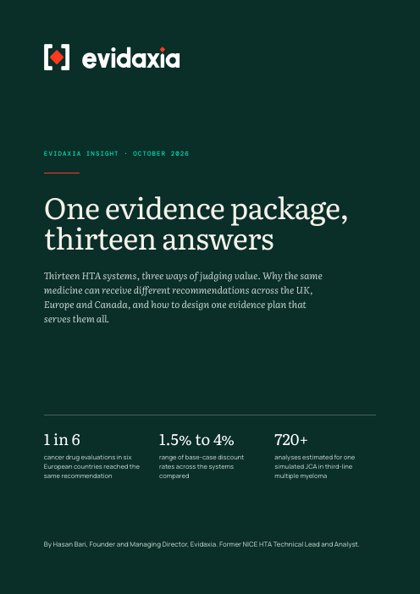
One evidence package, thirteen answers.
Our 21-page guide compares thirteen HTA systems across the UK, Europe and Canada, with 16 exhibits and full references. Subscribe to Evidaxia Briefing, our sourced analysis of market access, HTA decisions, evidence and health policy, and the guide downloads the moment you subscribe.
What is US most-favored-nation (MFN) drug pricing?
It is a US policy, set out in Executive Order 14297 of 12 May 2025, that aims to bring US drug prices in line with those in comparably developed countries. HHS defined the target as the lowest price in an OECD country with GDP per capita of at least 60% of the US level.
Which countries are in the GLOBE reference basket?
Nineteen: Australia, Austria, Belgium, Canada, the Czech Republic, Denmark, France, Germany, Ireland, Israel, Italy, Japan, the Netherlands, Norway, South Korea, Spain, Sweden, Switzerland and the United Kingdom. GENEROUS uses a smaller basket of eight, including the UK but not Ireland.
How does the GDP (PPP) adjustment work in GLOBE?
Each country price is multiplied by US real GDP (PPP) per capita divided by that country's, rounded to three decimals, with a floor of 1.000. CMS uses World Bank data, with the IMF as fallback, and publishes the adjusters quarterly.
When does the GLOBE model start?
The final rule takes effect on 30 November 2026. The model begins on 1 January 2027 with voluntary data submission, and the first performance year starts on 1 April 2027. PhRMA has challenged the rule in court.
What is the status of the GUARD model for Medicare Part D?
GUARD was proposed in December 2025. As of October 2026 the final rule had not been published and was reported to be under review at the Office of Management and Budget.
Do confidential NICE or HSE discounts affect US MFN benchmarks?
It depends on the model. GENEROUS and GLOBE Method II use manufacturer-reported net prices, which include confidential discounts. GLOBE Method I relies on data sources that CMS acknowledges do not capture the full range of confidential discounts.
Related analysis
Launching in Europe with US MFN exposure? Let us map it first.
Start with a free, no-obligation 30-minute call with a senior consultant.