
AI in global health technology assessment: where the guidance stands, and where the gaps are
Of eleven major HTA bodies reviewed, only NICE has issued a full position statement on AI in evidence generation. Regulators are moving faster. Here is what that means for submissions being prepared now.
Executive summary
The integration of artificial intelligence into health technology assessment is no longer hypothetical. Evidence generation processes, economic modelling workflows, and systematic literature reviews are all being touched by AI tools. Yet most of the agencies that make reimbursement decisions have not told manufacturers what they expect.
The central findingOf eleven major HTA bodies reviewed, only one (NICE) has issued a full position statement on AI in evidence generation. Two others (IQWiG, EUnetHTA) mention AI in methodological guidance. The remaining eight have issued nothing formal. Meanwhile, regulators at EMA and FDA are moving decisively.
This matters for anyone building a market access strategy today. Manufacturers are using AI tools to assist literature searches, model construction, and real-world evidence analysis, without knowing whether the receiving agency will accept, reject, or simply not know how to evaluate what they have produced.
This report maps where the guidance currently stands, what each agency has actually said or signalled, and what the absence of guidance means for submissions being prepared right now.
NICE: the first to move, still moving
The most detailed HTA-specific guidance on AI to date comes from England. On 15 August 2024, NICE published ECD11, its position statement on the use of AI methods in the generation and reporting of evidence considered by its evaluation programmes.[1] It remains the only full HTA-body position statement on AI in evidence generation worldwide as of a global review conducted in late 2024.[2, 3]
The document’s core message is proportionality. AI should only be used when there is a clear rationale for doing so, augmenting rather than replacing human involvement.[1] Submissions should not lead with AI-derived evidence where conventional alternatives exist. Where AI is used, validation must be documented, potential biases addressed, and methods aligned with established reporting standards including TRIPOD+AI, PALISADE, and the 2024 Cochrane guidance on AI in systematic reviews.
NICE draws a particularly sharp line around comparative treatment effect estimation. AI methods used in this context carry higher risk given their direct influence on cost-effectiveness conclusions.[1] The guidance expects sensitivity analyses, triangulation with clinical evidence, and full methodological transparency. Early engagement with NICE before using AI in a planned submission is explicitly encouraged. NICE has also produced a companion statement of intent (ECD12) that outlines its own internal AI ambitions.[4]
NICE HTA Lab: August 2025Two new projects launched: ‘Artificial intelligence in HTA’ (exploring generative AI across economic modelling from conceptualisation through validation) and ‘The future of HTA with AI’ (automation, predictive modelling, reasoning systems). These are not peripheral pilots.
In August 2025, NICE initiated two new projects within its HTA Innovation Laboratory.[5] In December 2025, NICE updated its technology appraisal manual to formally incorporate ‘HealthTech’ as a defined category, explicitly covering digital technologies including AI.[6] In February 2026, the National Healthtech Access Programme (NHAP) launched, with AI tools for detecting prostate and breast cancer among its first two appraisal topics.[7] AI is now not only a methodological consideration within NICE submissions. It is itself a subject of appraisal.
Canada: a position statement and a practical tool
Canada’s Drug Agency (CDA-AMC) published its AI position statement in early 2025, explicitly built on the NICE framework and aligned with all its core positions.[8] The Canadian statement situates requirements within the Artificial Intelligence and Data Act (AIDA) and existing voluntary responsible AI codes.
Beyond the position statement, CDA-AMC developed a dedicated evaluation instrument for AI search tools, designed to monitor and assess evolving technologies on an ongoing basis.[2] This is a more dynamic posture, signalling intent to keep pace with the technology rather than issue static documents that rapidly become outdated.
Quebec’s provincial HTA body, INESSS, has gone further still internally, building a GPT-4-based publication screening tool for its own literature review processes.[2] This sub-national initiative reflects the broader pressure on agencies to do more with constrained resources, and it anticipates the questions that will arise when manufacturers use similar tools in their own evidence generation.
The regulatory flank: EMA and FDA are moving faster
Medicines regulators have moved with considerably more momentum than HTA agencies. The evidence base feeding into submissions is increasingly shaped by regulatory-grade AI-assisted research, which means regulatory guidance will set de facto standards for HTA even before HTA agencies have acted.
The EMA’s Multi-Annual AI Workplan (2023-2028), developed with the Heads of Medicines Agencies, sets out guidance and policy, tools and technology, collaboration and training, and experimentation as four core pillars.[9] Its reflection paper on AI in the medicinal product lifecycle was published in September 2024.[10] In March 2025, EMA issued its first qualification opinion on an AI-based methodology, approving an AI tool for measuring liver histology in NASH/MASH clinical trials.[11]
The FDA published its first-ever draft guidance on AI in regulatory decision-making on 6 January 2025.[12] It was informed by more than 500 drug and biological product submissions with AI components received since 2016.[13] By May 2025, FDA had completed its generative AI pilot for scientific reviewers and moved to agency-wide deployment.[14] In January 2026, EMA and FDA jointly published ten principles for good AI practice in drug development.[15]
The rest of the field: patchy but moving
A systematic review of guidance documents presented at ISPOR 2025, covering fourteen country HTA bodies and EUnetHTA, confirmed that only NICE, IQWiG, and EUnetHTA have outlined any AI or machine learning use in evidence generation.[2] Most bodies still have nothing formal.
Germany’s IQWiG included a narrow provision in version 7.0 of its General Methods document (September 2023), permitting the use of validated machine learning classifiers for RCT identification in systematic literature searches, subject to case-by-case testing.[16] The concession is real, though deliberately narrow. IQWiG’s current head has publicly described AI-generated dossier text as ‘boring’, arguing that the fraction of a submission distinguishing a genuinely persuasive document from a filled-in template is precisely where AI falls short.[17] The former head was sharper still, characterising AI-generated virtual patient populations as an attempt to substitute data for evidence.
France’s HAS announced in April 2025 that it is evaluating AI for internal literature review support.[18] Scotland’s SMC defers to NICE methodology. Ireland’s NCPE has acknowledged the potential of machine learning in reviews without providing operational guidance. PBAC in Australia, TLV in Sweden, and ZIN in the Netherlands have each updated methodological documents in 2024-25 without AI-specific provisions.[19, 20]
The EU AI ActThe EU AI Act entered into force in August 2024 and is progressively applying to high-risk applications in healthcare. HTA bodies operating within EU member states will eventually need to engage with it directly, particularly as AI-enabled technologies move through the Joint Clinical Assessment process.
HTAi Global Policy Forum 2025: real recommendations
The HTAi Global Policy Forum in January 2025 (Cascais, Portugal) brought together 94 delegates from HTA agencies, payers, pharmaceutical companies, and device manufacturers for three days focused on AI in HTA, producing a published white paper with concrete recommendations.[21, 22]
The forum confirmed that generative AI is already being used across HTA activities: systematic literature reviews, network meta-analyses, analysis of clinical evidence.[22] The consensus was that GenAI tools should function as extensions to human expertise, not replacements. Transparency, accountability, and validation against external standards were identified as the non-negotiable requirements.
The forum also raised harder concerns. Unequal access to AI tools could introduce new inequities into the global HTA process. Over-reliance risks eroding the critical appraisal skills within agencies that are the foundation of credible assessment.[22] The HTAi working group recommended developing risk-matrix and transparency checklists for GenAI use in HTA, co-created across agencies and industry. A further GPF is scheduled for March 2026.
The EU HTA Regulation: a structural shift without an AI clause
Since 12 January 2025, the EU HTA Regulation has been live for oncology drugs and advanced therapy medicinal products.[23] Joint Clinical Assessments, conducted by paired national agencies, now form the basis of EU-level clinical evidence review for these products. The regulation extends to orphan medicines in 2028 and all new medicines in 2030. Joint Scientific Consultations opened for submissions in January 2026.
The JCA framework changes the structure of how comparative clinical evidence is reviewed across Europe. It does not specifically address AI. As AI-supported evidence becomes more common in dossiers, the JCA process will need shared evaluation standards that do not yet exist at the EU level.[23]
What this means in practice
The comparison to real-world evidence is instructive. RWE was used in submissions for years before agencies developed coherent evaluation frameworks. Manufacturers navigated ambiguity. Agencies made case-by-case decisions. Guidance arrived late and piecemeal. That trajectory took roughly a decade. AI is moving faster, with less interpretable tools, and the window to get ahead of it is shorter.[3, 20]
The German position is a useful counterweight to optimism. IQWiG’s concern that AI will be used to paper over evidentiary gaps that randomised data would be needed to close is not irrational. It is precisely the risk.[17] Manufacturers who want AI-supported submissions taken seriously will need to demonstrate that their methods address this concern directly, not merely satisfy checklist requirements.
For agencies, capacity is the most urgent problem. Reviewers who cannot interrogate a machine learning model’s performance characteristics, or assess whether an LLM-assisted literature screen met appropriate validation standards, cannot hold manufacturers to account. The HTAi Forum flagged this explicitly.[22] Training, literacy, and internal tool development are prerequisites for credible assessment in the coming decade.
The bottom lineNICE’s August 2024 position statement was the starting point. The HTA Lab projects, NHAP launch, and updated TA manual suggest England is building seriously on it. Canada has followed. The international community is asking the right questions. Most agencies still need to act.
References
- National Institute for Health and Care Excellence. Use of AI in evidence generation: NICE position statement (ECD11) [Internet]. London: NICE; 2024 Aug 15 [cited 2026 Apr 10]. Available from: https://www.nice.org.uk/corporate/ecd11
- Ting E, Badin M, Gaind N, Hofer K, Pourrahmat MM, Ivkovic L, et al. Artificial intelligence integration in health technology assessments: a review of global policies and practices [poster MSR109]. Poster presented at: ISPOR 2025; 2025 May; Montréal, Canada. Available from: https://www.ispor.org/heor-resources/presentations-database/presentation-cti/ispor-2025/poster-session-4/artificial-intelligence-integration-in-health-technology-assessments-a-review-of-global-policies-and-practices
- Fleurence RL, Bian J, Wang X, Xu H, Dawoud D, Higashi M, et al. Generative artificial intelligence for health technology assessment: opportunities, challenges, and policy considerations: an ISPOR Working Group report. Value Health. 2025;28(2):175-83. doi:10.1016/j.jval.2024.10.3846 Available from: https://www.sciencedirect.com/science/article/abs/pii/S1098301524067548
- National Institute for Health and Care Excellence. Statement of intent for artificial intelligence (AI) (ECD12) [Internet]. London: NICE; 2024 [cited 2026 Apr 10]. Available from: https://www.nice.org.uk/corporate/ecd12
- Med Tech Reimbursement Consulting. NICE HTA Lab: two new AI projects initiated [Internet]. [place unknown]: Med Tech Reimbursement Consulting; 2025 Aug [cited 2026 Apr 10]. Available from: https://mtrconsult.com/news/nice-hta-lab-projects-explore-use-ai-economic-modelling-and-hta-processes
- Med Tech Reimbursement Consulting. NICE manual for technology appraisal and highly specialised technologies [Internet]. [place unknown]: Med Tech Reimbursement Consulting; 2025 Dec [cited 2026 Apr 10]. Available from: https://mtrconsult.com/news/nice-manual-technology-appraisal-and-highly-specialised-technologies-updated-england
- Med Tech Reimbursement Consulting. NICE launches National Healthtech Access Programme (NHAP) [Internet]. [place unknown]: Med Tech Reimbursement Consulting; 2026 Feb [cited 2026 Apr 10]. Available from: https://mtrconsult.com/news/nice-implemented-new-healthtech-program-england
- Canada's Drug Agency (CDA-AMC). Position statement on the use of artificial intelligence in the generation and reporting of evidence [Internet]. Ottawa: CDA-AMC; 2025 [cited 2026 Apr 10]. Available from: https://www.cda-amc.ca/sites/default/files/MG%20Methods/Position_Statement_AI_Renumbered.pdf
- European Medicines Agency and Heads of Medicines Agencies. Multi-Annual Artificial Intelligence Workplan 2023-2028 [Internet]. Amsterdam: European Medicines Agency and Heads of Medicines Agencies; 2023 Dec [cited 2026 Apr 10]. Available from: https://www.ema.europa.eu/en/documents/work-programme/multi-annual-artificial-intelligence-workplan-2023-2028-hma-ema-joint-big-data-steering-group_en.pdf
- European Medicines Agency. The use of Artificial Intelligence (AI) in the medicinal product lifecycle [Internet]. Amsterdam: European Medicines Agency; 2024 Sep [cited 2026 Apr 10]. Available from: https://www.ema.europa.eu/en/about-us/how-we-work/data-regulation-big-data-other-sources/artificial-intelligence
- European Medicines Agency. Qualification opinion for AI-based measurement of non-alcoholic steatohepatitis histology in liver biopsies (AIM-NASH tool) [Internet]. Amsterdam: European Medicines Agency; 2025 Mar [cited 2026 Apr 10]. Available from: https://www.ema.europa.eu/en/about-us/how-we-work/data-regulation-big-data-other-sources/artificial-intelligence
- US Food and Drug Administration. Considerations for the Use of Artificial Intelligence to Support Regulatory Decision-Making for Drug and Biological Products [Internet]. Silver Spring (MD): US Food and Drug Administration; 2025 Jan 6 [cited 2026 Apr 10]. Available from: https://www.fda.gov/regulatory-information/search-fda-guidance-documents/considerations-use-artificial-intelligence-support-regulatory-decision-making-drug-and-biological
- US Food and Drug Administration. FDA proposes framework to advance credibility of AI models used for drug and biological product submissions [Internet]. Silver Spring (MD): US Food and Drug Administration; 2025 Jan 6 [cited 2026 Apr 10]. Available from: https://www.fda.gov/news-events/press-announcements/fda-proposes-framework-advance-credibility-ai-models-used-drug-and-biological-product-submissions
- US Food and Drug Administration. FDA announces completion of first AI-assisted scientific review pilot and aggressive agency-wide AI strategy [Internet]. Silver Spring (MD): US Food and Drug Administration; 2025 May 8 [cited 2026 Apr 10]. Available from: https://www.fda.gov/news-events/press-announcements/fda-announces-completion-first-ai-assisted-scientific-review-pilot-and-aggressive-agency-wide-ai
- European Medicines Agency. EMA and FDA set common principles for AI in medicine development [Internet]. Amsterdam: European Medicines Agency; 2026 Jan [cited 2026 Apr 10]. Available from: https://www.ema.europa.eu/en/news/ema-fda-set-common-principles-ai-medicine-development-0
- Institut für Qualität und Wirtschaftlichkeit im Gesundheitswesen (IQWiG). General methods, version 7.0 [Internet]. Cologne: IQWiG; 2023 Sep [cited 2026 Apr 10]. Available from: https://www.iqwig.de/en/about-us/methods/methods-paper/
- Dietrich ES. Artificial intelligence in key pricing, reimbursement, and market access (PRMA) processes: better, faster, cheaper: can you really pick two? J Med Econ. 2025;28(1):586-95. doi:10.1080/13696998.2025.2488154 Available from: https://www.tandfonline.com/doi/full/10.1080/13696998.2025.2488154
- Haute Autorité de Santé. La HAS evalue le potentiel de l'IA pour assister le processus de revue de litterature [Internet]. Saint-Denis: Haute Autorité de Santé; 2025 Apr [cited 2026 Apr 10]. Available from: https://www.has-sante.fr/jcms/p_3599818/fr/la-has-evalue-le-potentiel-de-l-ia-pour-assister-le-processus-de-revue-de-litterature
- Rtveladze K, Oikonomidi T, Ferizovic N, Pulleddula K, Geddamuri BG, Agrawal P, et al. Use of artificial intelligence and machine learning (AI/ML) in systematic literature reviews (SLR): review of state-of-the-art health technology assessment (HTA) and future directions [poster HTA284]. Poster presented at: ISPOR Europe 2024; 2024 Nov; Barcelona, Spain. Available from: https://www.ispor.org/heor-resources/presentations-database/presentation/euro2024-4016/144969
- Putnam Associates. Acceptance of Artificial Intelligence in Evidence and Dossier Developments by HTA Bodies: Challenges and Opportunities [Internet]. Boston (MA): Putnam Associates; 2025 Nov [cited 2026 Apr 10]. Available from: https://www.putassoc.com/insights/acceptance-of-artificial-intelligence-in-evidence-and-dossier-developments-by-hta-bodies-challenges-and-opportunities/
- Trowman R, Boysen M, Migliore A, Valiotis G. Advancing the use of artificial intelligence in health technology assessment activities: insights and next steps from the 2025 HTAi Global Policy Forum. Int J Technol Assess Health Care. 2026;42(1):e5. doi:10.1017/S0266462325103395 Available from: https://www.cambridge.org/core/journals/international-journal-of-technology-assessment-in-health-care/article/advancing-the-use-of-artificial-intelligence-in-health-technology-assessment-activities-insights-and-next-steps-from-the-2025-htai-global-policy-forum/D5B78B653F97C26FED906A5D9CE4D505
- Health Technology Assessment international (HTAi). 2025 Global Policy Forum White Paper: The Journey to the Digitalization of HTA. The Role of Artificial Intelligence in HTA Lifecycle Activities [Internet]. Edmonton: Health Technology Assessment international (HTAi); 2025 Apr [cited 2026 Apr 10]. Available from: https://htai.org/wp-content/uploads/2025/05/HTAiGPF2025_WhitePaper.pdf
- RTI Health Solutions. Joint clinical assessment rules on health tech assessment now in effect: new era for patient access to innovation [Internet]. Research Triangle Park (NC): RTI Health Solutions; 2025 [cited 2026 Apr 10]. Available from: https://www.rtihs.org/resource/update/joint-clinical-assessment-rules-health-tech-assessment-now-effect-new-era-patient
First published in the Evidaxia newsletter on LinkedIn, 10 April 2026. Charts from the original edition are not reproduced here. All sources were verified and accessible as of April 2026.
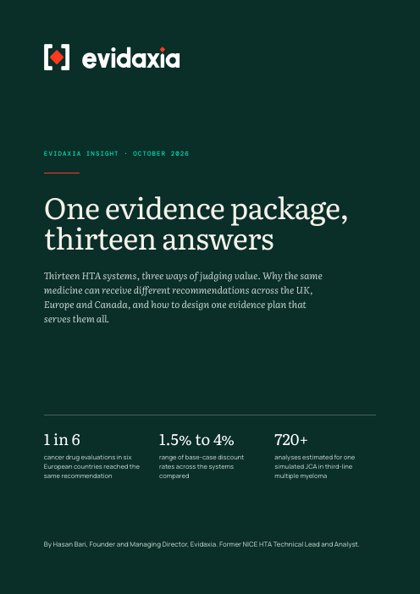
One evidence package, thirteen answers.
Our 21-page guide compares thirteen HTA systems across the UK, Europe and Canada, with 16 exhibits and full references. Subscribe to Evidaxia Briefing, our sourced analysis of market access, HTA decisions, evidence and health policy, and the guide downloads the moment you subscribe.